🤖 Fully Robotic Human-Form Agents: Autonomous Replacements and Collaborators in Military, Policing, Rescue and Firefighting

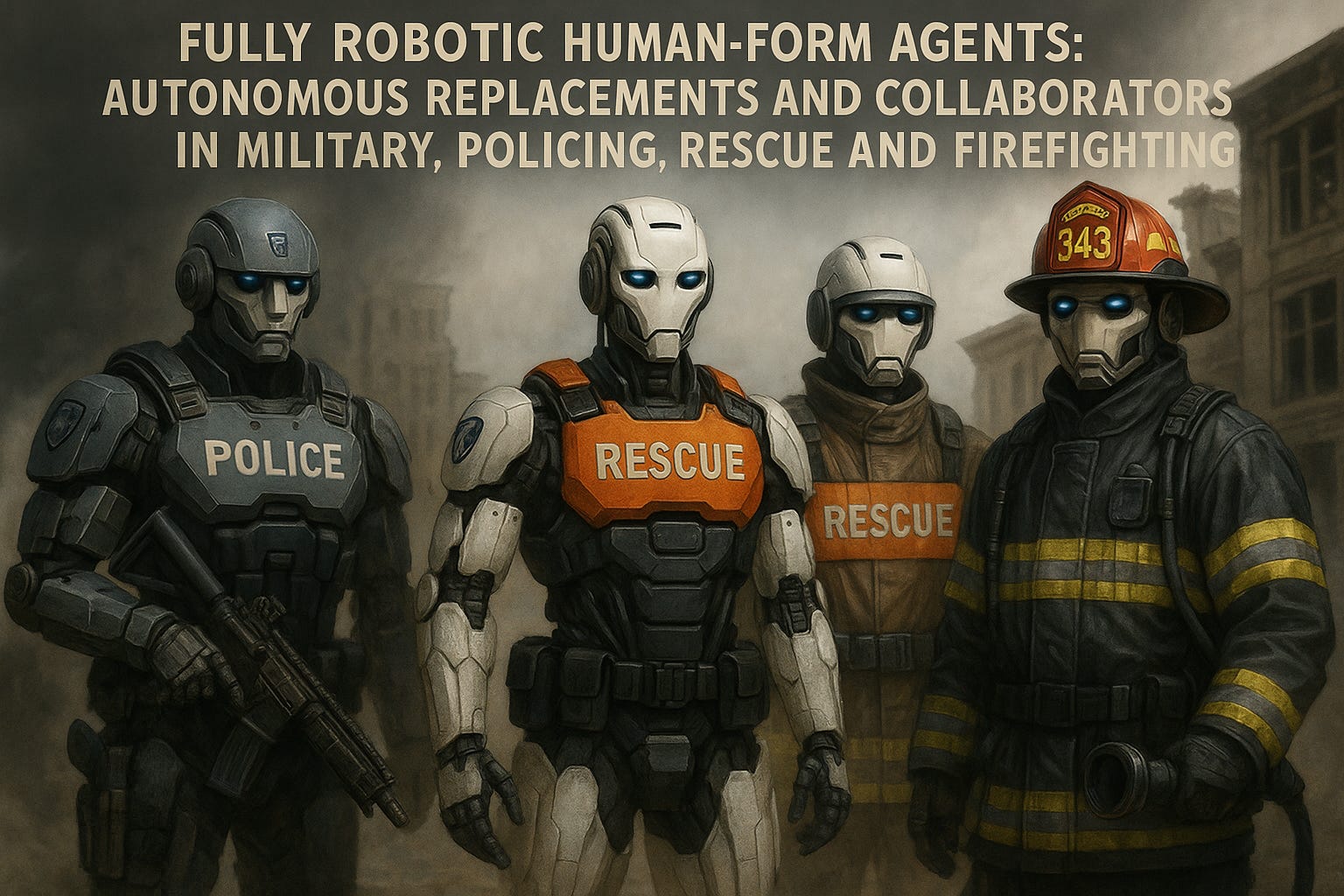
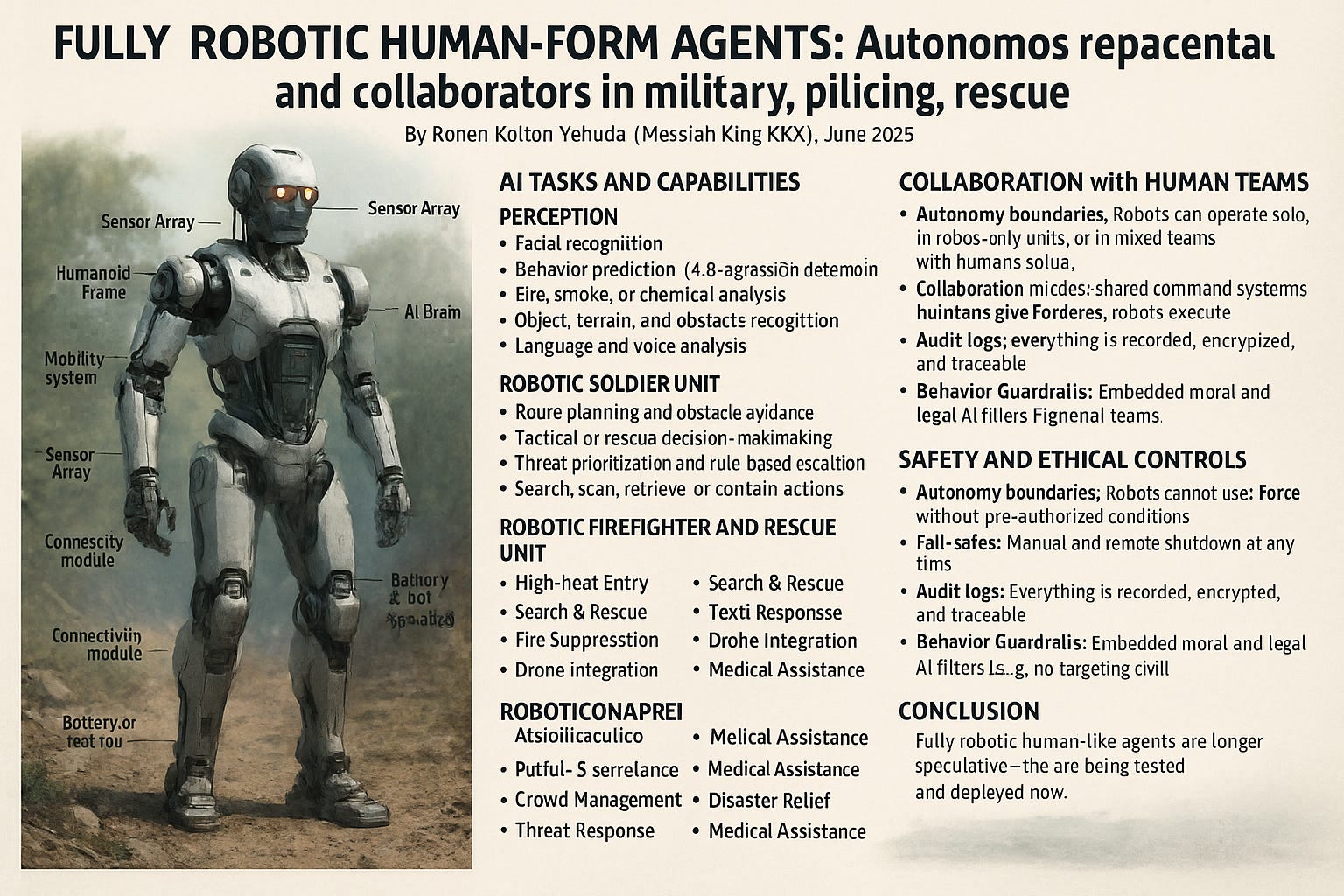
🤖 Fully Robotic Human-Form Agents: Autonomous Replacements and Collaborators in Military, Policing, Rescue, and Firefighting
By Ronen Kolton Yehuda (Messiah King RKY), June 2025
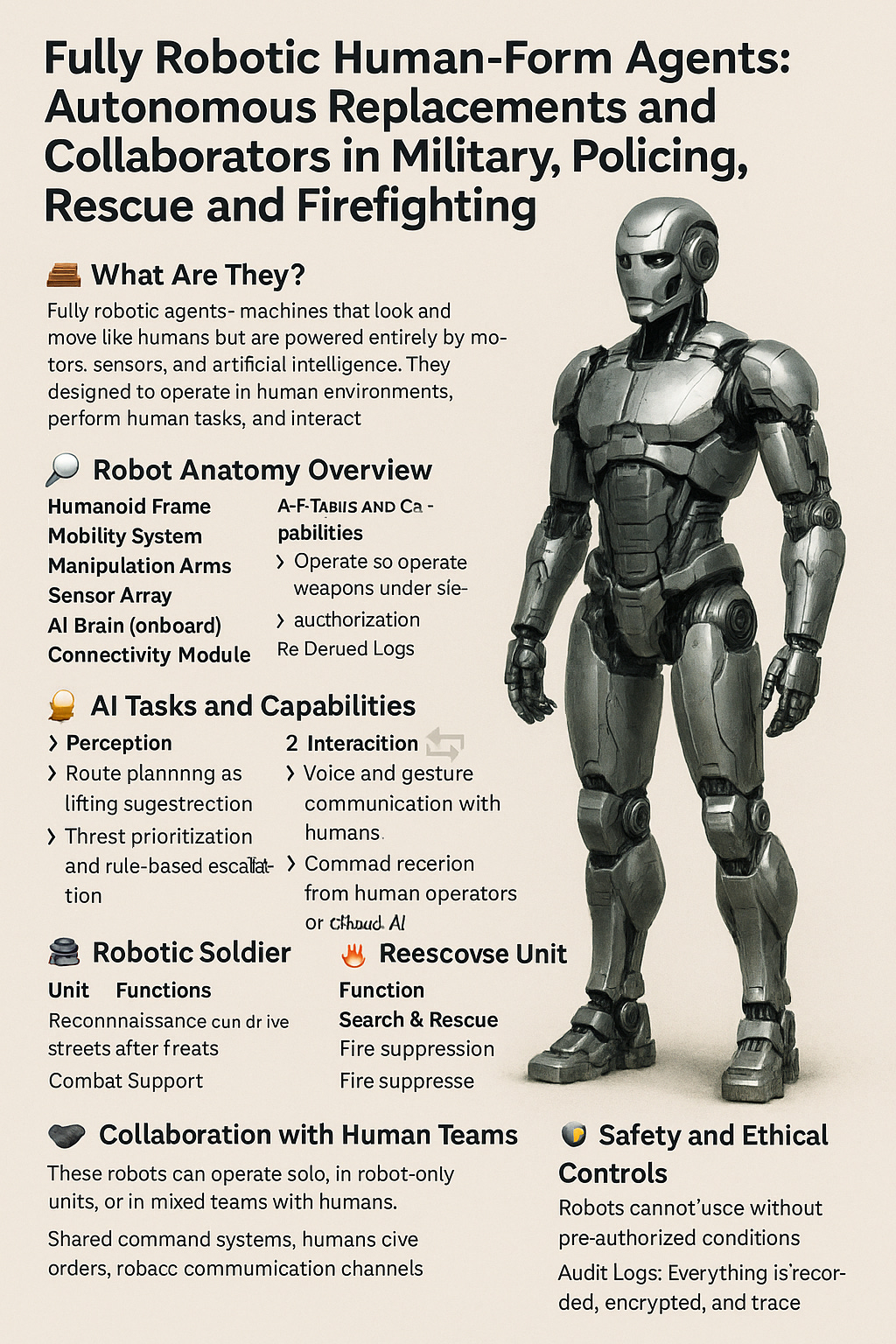
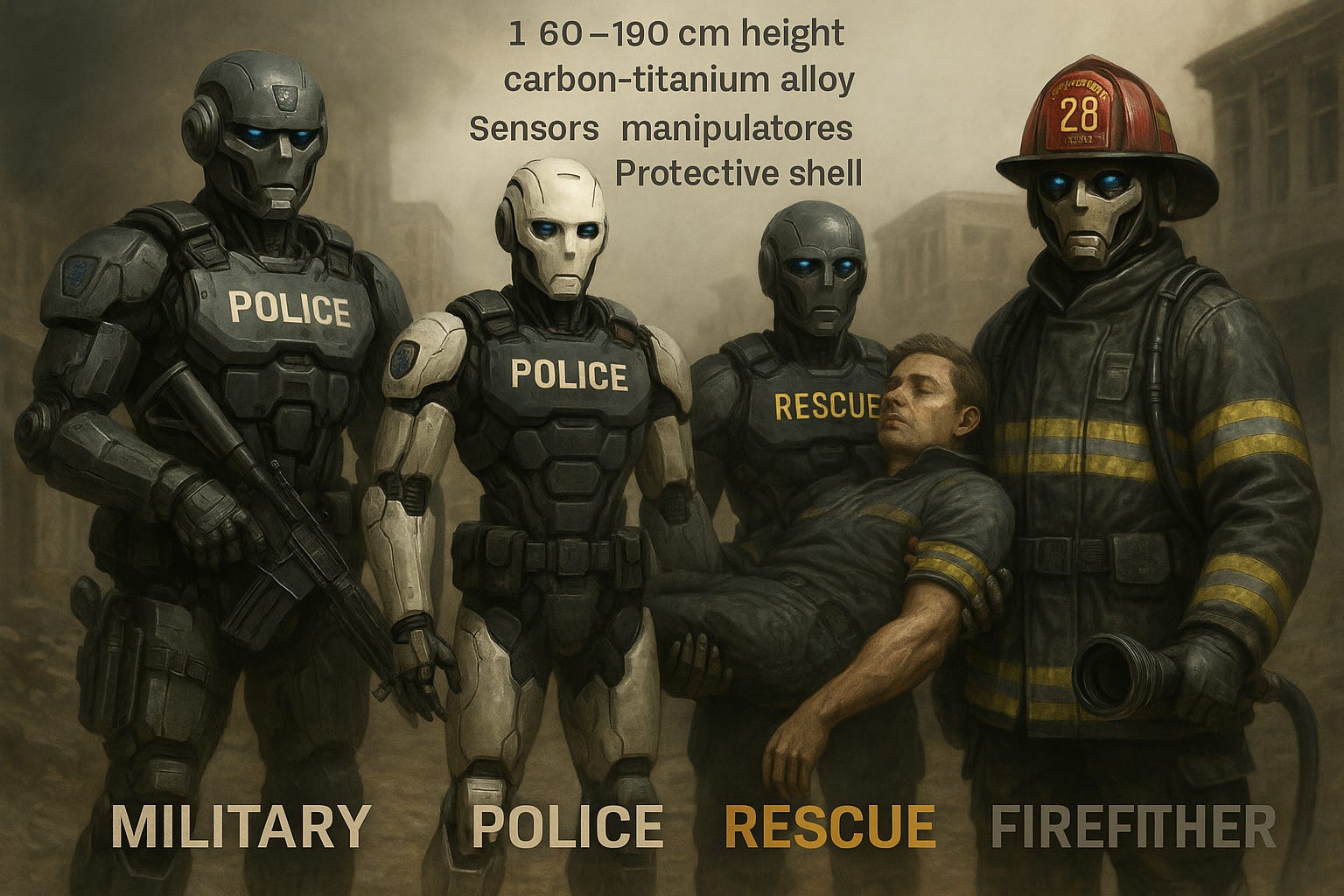
🔍 What Are They?
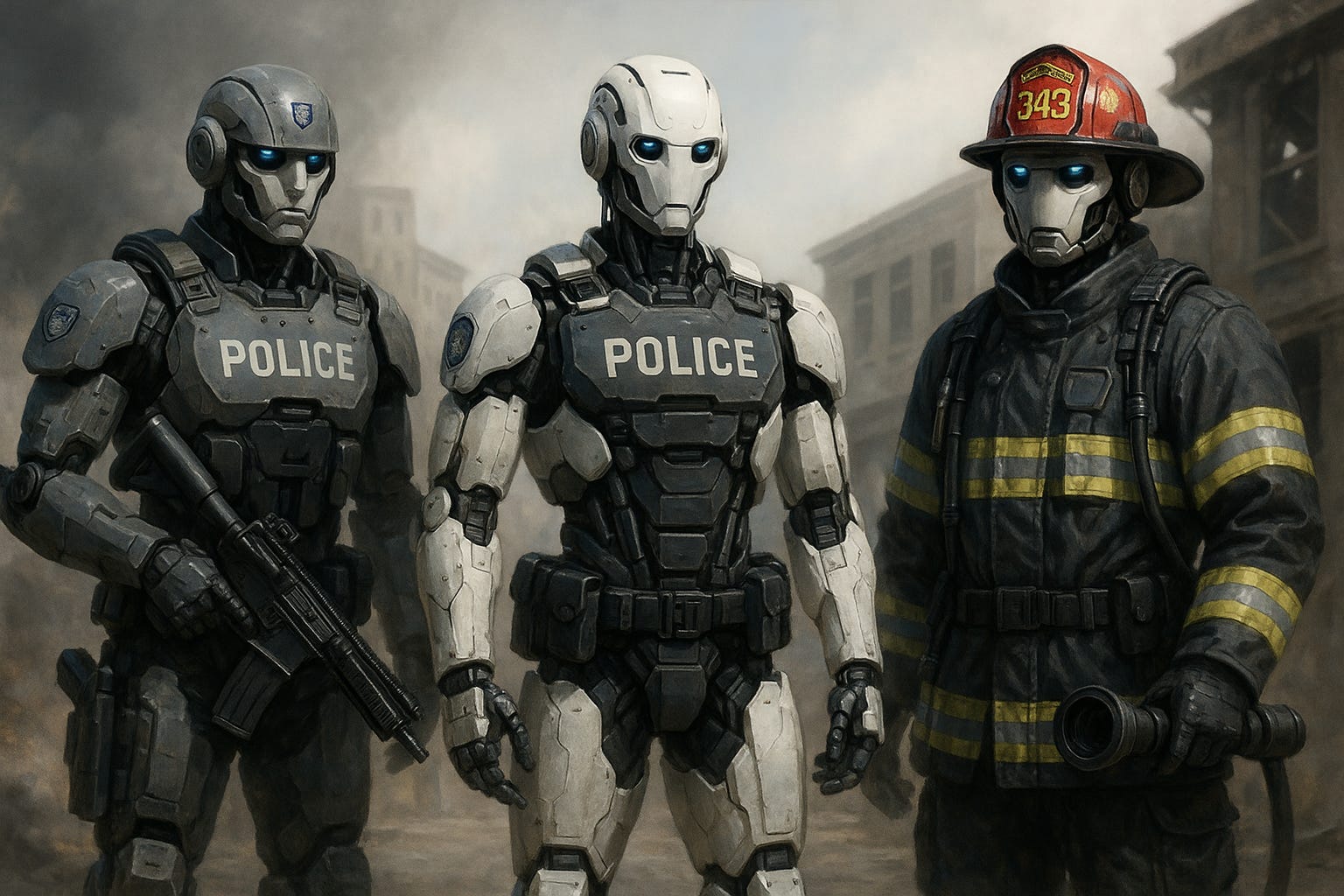
These are fully robotic agents—machines that look and move like humans but are powered entirely by motors, sensors, and artificial intelligence. They are designed to operate in human environments, perform human tasks, and interact with people or machines as part of coordinated missions.
They are not controlled by humans wearing suits or operating remote joysticks—they walk, think, and act using onboard AI and embedded logic.
🧱 Robot Anatomy Overview
Subsystem Description
Humanoid Frame Human-sized robot body with legs, arms, head, and hands, allowing it to move through doors, stairs, and vehicles
Mobility System Bipedal legs with gyroscopic balancing, or hybrid legs/wheels for agility
Manipulation Arms Dexterous arms for lifting, carrying, opening doors, using tools, or non-lethal weapons
Sensor Array 360° vision, thermal imaging, LIDAR, radar, microphones, gas detection, biometric scanning
AI Brain (onboard) Decision-making system for perception, planning, navigation, communication, and task execution
Connectivity Module Wi-Fi, 5G, or mesh network link to human teams or cloud command systems
Power Supply Battery or fuel cell providing 3–8 hours of operation; swap or recharge as needed
🧠 AI Tasks and Capabilities
Fully robotic agents operate independently within assigned protocols. Their AI handles:
1. Perception
Facial recognition
Behavior prediction (e.g., aggression detection in riots)
Fire, smoke, or chemical analysis
Object, terrain, and obstacle recognition
Language and voice analysis
2. Action Planning
Route planning and obstacle avoidance
Tactical or rescue decision-making
Threat prioritization and rule-based escalation
Search, scan, retrieve, or contain actions
3. Interaction
Voice and gesture communication with humans
Warning systems, negotiation, public announcements
Command reception from human operators or cloud AI
🔫 Robotic Soldier Unit
Function Capability
Reconnaissance Scout dangerous zones before human entry
Combat Support Carry and operate weapons under strict authorization
Rescue & Extraction Retrieve wounded soldiers under fire
Target Coordination Laser marking and drone sync
Stealth Movement Navigate buildings, forests, or battlefields autonomously
🚓 Robotic Police Unit
Function Capability
Patrol & Surveillance Walk or drive streets with live camera and behavioral monitoring
Crowd Management Predict movement, provide verbal warnings, deploy barriers or foam
Threat Response Use non-lethal tools (tasers, nets, drones) to stop violence
Identification Face and ID scan to verify individuals or detect wanted suspects
Evidence Recording Store encrypted audio-video logs for court and auditing
🔥 Robotic Firefighter and Rescue Unit
Function Capability
High-Heat Entry Enter burning or collapsing buildings safely
Search & Rescue Detect victims using thermal imaging and heartbeat sensors
Fire Suppression Operate hoses, nozzles, or extinguishers from within danger zones
Toxic Response Identify and isolate gas leaks, radiation, or biohazards
Drone Integration Guide aerial or crawler drones into tight or high-risk zones
Disaster Relief Lift debris, distribute supplies, and coordinate evacuations
Medical Assistance Stabilize and carry injured civilians from danger zones
🤝 Collaboration with Human Teams
These robots can operate solo, in robot-only units, or in mixed teams with humans. Collaboration includes:
Shared command systems (humans give orders, robots execute)
Autonomous zones (robot covers area where humans can’t go)
Robots handle danger, humans make decisions
Secure communication channels (AI translates and syncs data in real time)
🛡️ Safety and Ethical Controls
Autonomy Boundaries: Robots cannot use force without pre-authorized conditions
Fail-safes: Manual and remote shutdown at any time
Audit Logs: Everything is recorded, encrypted, and traceable
Behavior Guardrails: Embedded moral and legal AI filters (e.g., no targeting civilians)
🏗️ Current Real-World Examples
China: Advanced humanoid robots for industrial and military trials (Fourier Intelligence, Unitree Robotics)
USA: Tesla Optimus, Boston Dynamics Atlas, and Ghost Robotics for defense and emergency tasks
South Korea, Japan: Firefighting and rescue robots in urban environments
Israel and Europe: Public security and disaster response robots in municipal trials
🧭 Conclusion
Fully robotic human-like agents are no longer speculative—they are being tested and deployed now. They will soon:
Replace humans in the most dangerous roles
Collaborate in rescue and security missions
Operate 24/7 without fatigue or fear
Sync seamlessly with smart cities, drones, and human teams
They are not just machines—they are autonomous co-workers in human-shaped form, engineered to act when humans cannot.
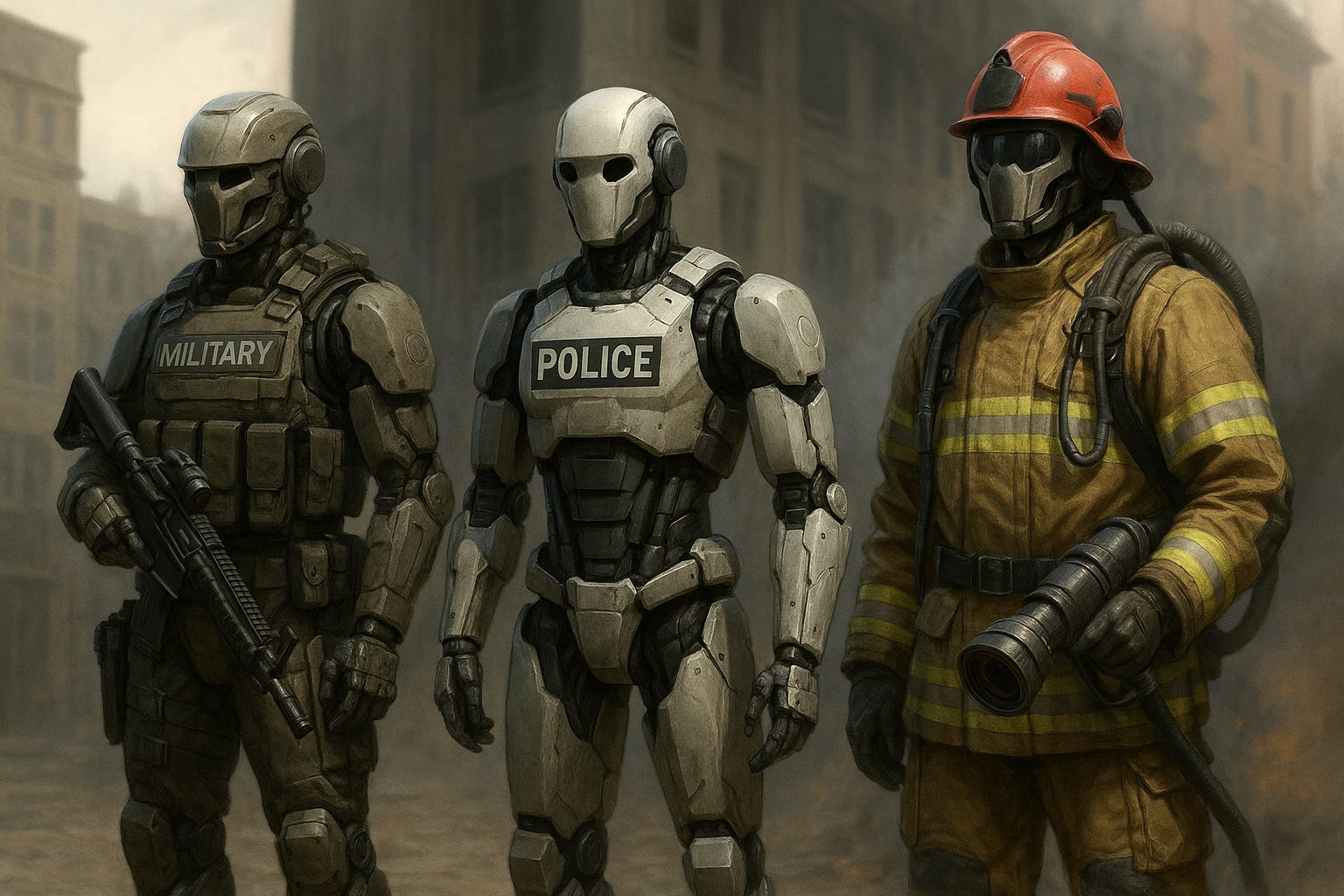
🤖 Fully Robotic Human-Form Agents: Autonomous Replacements and Collaborators in Military, Policing, and Firefighting
🔍 What Are They?
These are fully robotic agents—machines that look and move like humans but are powered entirely by motors, sensors, and artificial intelligence. They are designed to operate in human environments, perform human tasks, and interact with people or machines as part of coordinated missions.
They are not controlled by humans wearing suits or operating remote joysticks—they walk, think, and act using onboard AI and embedded logic.
🧱 Robot Anatomy Overview
Subsystem Description
Humanoid Frame Human-sized robot body with legs, arms, head, and hands, allowing it to move through doors, stairs, and vehicles
Mobility System Bipedal legs with gyroscopic balancing, or hybrid legs/wheels for agility
Manipulation Arms Dexterous arms for lifting, carrying, opening doors, using tools, or non-lethal weapons
Sensor Array 360° vision, thermal imaging, LIDAR, radar, microphones, gas detection, biometric scanning
AI Brain (onboard) Decision-making system for perception, planning, navigation, communication, and task execution
Connectivity Module Wi-Fi, 5G, or mesh network link to human teams or cloud command systems
Power Supply Battery or fuel cell providing 3–8 hours of operation; swap or recharge as needed
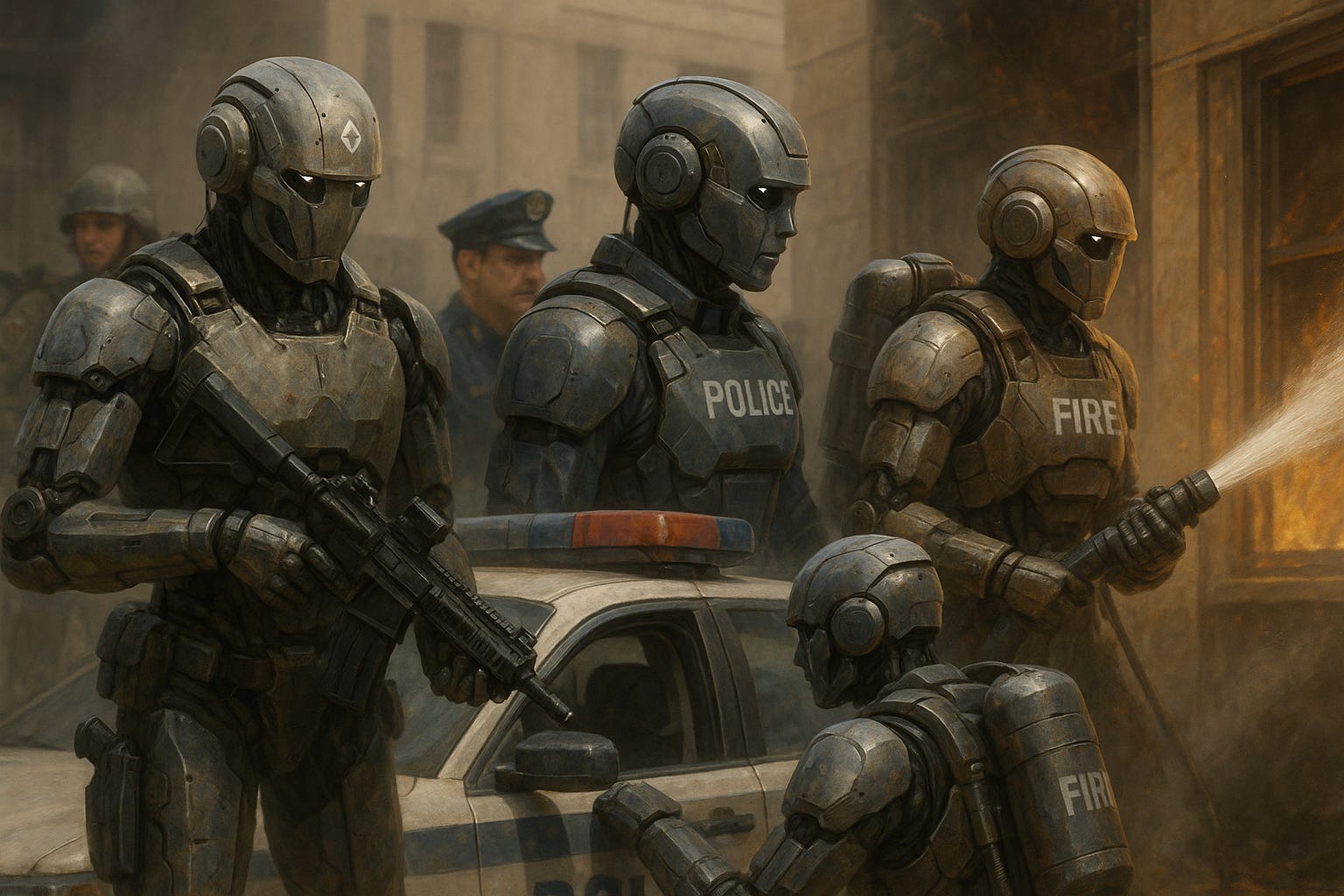
🧠 AI Tasks and Capabilities
Fully robotic agents operate independently within assigned protocols. Their AI handles:
1. Perception
Facial recognition
Behavior prediction (e.g., aggression detection in riots)
Fire, smoke, or chemical analysis
Object, terrain, and obstacle recognition
Language and voice analysis
2. Action Planning
Route planning and obstacle avoidance
Tactical or rescue decision-making
Threat prioritization and rule-based escalation
Search, scan, retrieve, or contain actions
3. Interaction
Voice and gesture communication with humans
Warning systems, negotiation, public announcements
Command reception from human operators or cloud AI
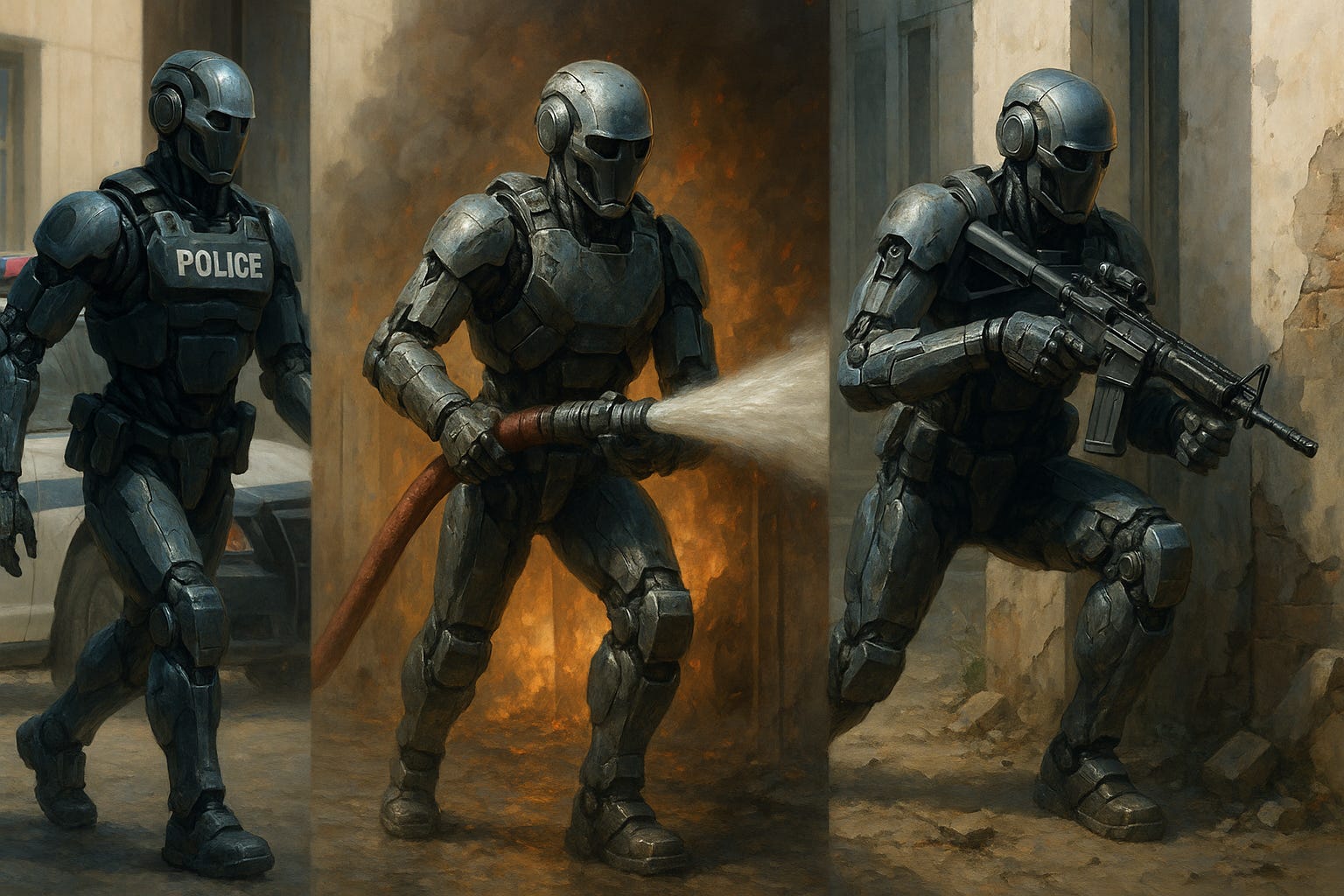
🔫 Robotic Soldier Unit
Function Capability
Reconnaissance Scout dangerous zones before human entry
Combat Support Carry and operate weapons under strict authorization
Rescue & Extraction Retrieve wounded soldiers under fire
Target Coordination Laser marking and drone sync
Stealth Movement Navigate buildings, forests, or battlefields autonomously
🚓 Robotic Police Unit
Function Capability
Patrol & Surveillance Walk or drive streets with live camera and behavioral monitoring
Crowd Management Predict movement, provide verbal warnings, deploy barriers or foam
Threat Response Use non-lethal tools (tasers, nets, drones) to stop violence
Identification Face and ID scan to verify individuals or detect wanted suspects
Evidence Recording Store encrypted audio-video logs for court and auditing
🔥 Robotic Firefighter Unit
Function Capability High-Heat Entry Enter burning or collapsing buildings safely Search & Rescue Detect victims using thermal imaging and heartbeat sensors Fire Suppression Operate hoses, nozzles, or extinguishers from within danger zones Toxic Response Identify and isolate gas leaks, radiation, or biohazards Drone Integration Guide aerial or crawler drones into tight or high-risk zones
🤝 Collaboration with Human Teams
These robots can operate solo, in robot-only units, or in mixed teams with humans. Collaboration includes:
Shared command systems (humans give orders, robots execute)
Autonomous zones (robot covers area where humans can’t go)
Robots handle danger, humans make decisions
Secure communication channels (AI translates and syncs data in real time)
🛡️ Safety and Ethical Controls
Autonomy Boundaries: Robots cannot use force without pre-authorized conditions
Fail-safes: Manual and remote shutdown at any time
Audit Logs: Everything is recorded, encrypted, and traceable
Behavior Guardrails: Embedded moral and legal AI filters (e.g., no targeting civilians)
🏗️ Current Real-World Examples
China: Advanced humanoid robots for industrial and military trials (Fourier Intelligence, Unitree Robotics)
USA: Tesla Optimus, Boston Dynamics Atlas, and Ghost Robotics for defense and emergency tasks
South Korea, Japan: Firefighting and rescue robots in urban environments
🧭 Conclusion
Fully robotic human-like agents are no longer speculative—they are being tested and deployed now. They will soon:
Replace humans in the most dangerous roles
Collaborate in rescue and security missions
Operate 24/7 without fatigue or fear
Sync seamlessly with smart cities, drones, and human teams
They are not just machines—they are autonomous co-workers in human-shaped form, engineered to act when humans cannot.
Here is a technical article focused specifically on Fully Robotic Human-Form Agents designed to replace or collaborate with humans in military, law enforcement, and firefighting roles:
Technical Framework for Fully Robotic Human-Form Agents in Military, Police, and Fire Response Operations
By Ronen Kolton Yehuda (Messiah King RKY), June 2025
Abstract
This article outlines the design architecture, functional modules, AI capabilities, operational logic, and deployment protocols of fully autonomous or semi-autonomous humanoid robotic agents engineered to replace or collaborate with human personnel in high-risk, high-stress frontline environments. Unlike wearable augmentations, these robots are independent actors equipped with multi-modal perception systems, mobile manipulation, mission-specific AI frameworks, and real-time communication interfaces.
1. System Architecture
1.1 Mechanical Structure
Component Description
Chassis Reinforced humanoid frame (160–190 cm height) constructed from carbon-titanium alloy
Mobility Unit Bipedal walking mechanism with gyroscopic stabilization; some variants include retractable wheels
Manipulator Arms Dual-arm setup with 6–8 DOF, force feedback, and interchangeable tool interfaces
Head Unit Sensor housing for vision, audio, radar, and environmental detection
Protective Shell Rated for thermal (up to 1200°C), ballistic, and chemical resistance, based on mission profile
Power Supply Modular Li-ion or solid-state battery with quick-swap ports; 3–8 hours runtime per module
2. Perception & Sensor Fusion
Sensor Type Role
RGB + IR Cameras Visual scene processing, object/person recognition, fire detection
LIDAR & RADAR 3D mapping, SLAM, obstacle detection in low-visibility environments
Acoustic Arrays Gunshot detection, voice command parsing, distress signal identification
Thermal Sensors Human presence detection in smoke, fog, or darkness
Gas/Chemical Sensors Hazard identification (CO, CH₄, SO₂, etc.) in firefighting or industrial settings
IMU + GPS Localization, orientation, fall correction, motion prediction
All sensor data is processed via onboard edge-AI and optionally synced with command cloud systems.
3. AI Task Management System
3.1 Core Functional AI Modules
Perception Layer: Multimodal input processing for objects, terrain, humans, hazards
Behavior Planning Layer: Hierarchical state machines and reinforcement learning policies
Action Execution Layer: Real-time actuation control with feedback loops
Communication Layer: Human-interpretable responses via voice, display, or signals
3.2 Role-Specific AI
Agent Role AI Capabilities
Military Target classification, threat prediction, cover optimization, drone coordination
Police Face/movement tracking, crowd prediction models, de-escalation behavior trees
Firefighting Heat flow simulation, escape path generation, victim search using thermal & heartbeat scans
4. Autonomy and Safety Logic
4.1 Autonomy Levels
Level 1: Human teleoperation
Level 2: Assistive autonomy (suggestions only)
Level 3: Conditional autonomy with human override
Level 4: Full autonomy with ethical constraints and override capability
4.2 Safety Protocols
Fail-Safe: If systems overheat, disconnect, or misclassify input, robot halts automatically
Ethical Guardrails: Asimov-style constraints prevent targeting humans unless authorized under law
Audit Trail: Encrypted action logging for post-operation review or legal validation
Override Interface: Mobile, voice, or command-center-based manual override control
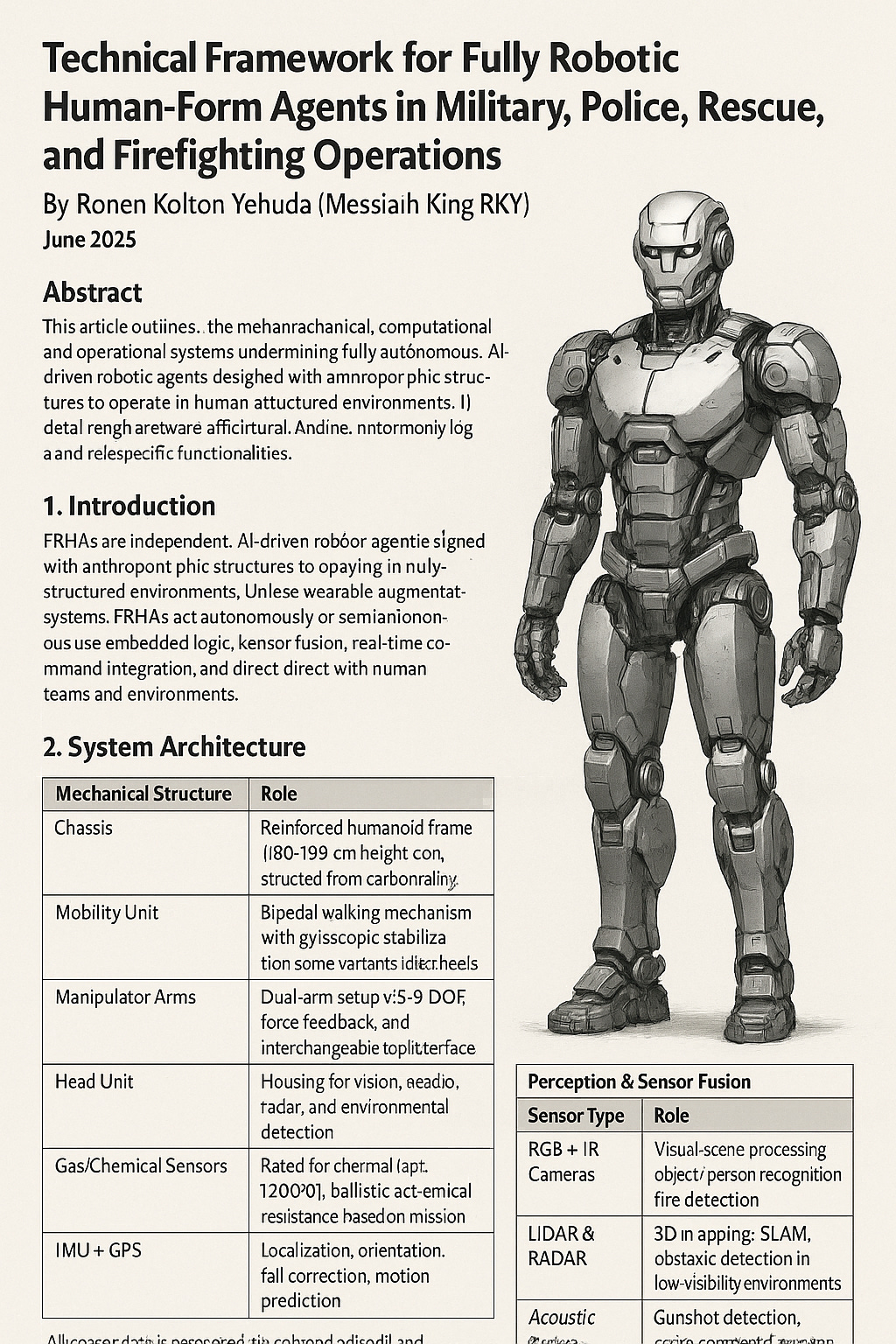
5. Manipulation & Task Execution
Function Capabilities
Mobility Walk, jog, climb stairs/ladders, cross debris, enter vehicles
Manual Tasks Lift, carry (up to 200 kg), open/close doors, operate hoses or weapons
Tool Use Attachments: Fire hose, drill, shield, non-lethal weapon, camera, stretcher arm
Victim Handling Securely lift and carry humans with soft-mode adaptive grip
6. Communications and Coordination
Network Stack: 5G, Wi-Fi 6, and short-range mesh protocols
Voice Interaction: Bidirectional speech with NLP and multi-language models
Inter-Agent Sync: Robotic units share maps, targets, and hazard data in real-time
Cloud Control: Remote operation or monitoring via secure cloud dashboards
7. Applications and Deployment Scenarios
7.1 Combat Operations
Urban and rural reconnaissance
Direct combat support under controlled engagement logic
Retrieval of injured personnel under fire
Mobile surveillance and perimeter security
7.2 Law Enforcement
Riot control (non-lethal enforcement with compliance AI)
Patrol and identification (facial recognition + behavior flagging)
Hostage situations (first contact, negotiation assistant)
Event security (visual scan, tracking, perimeter alerts)
7.3 Fire and Emergency Response
Entry into structures exceeding human survivability thresholds
Victim location via thermal and heartbeat sensors
Structural analysis and safe zone designation
On-site firefighting with mounted or carried extinguishers
8. Maintenance & Reliability
Subsystem Maintenance Interval Notes
Joints/Actuators 500 hrs Replaceable with quick-lock cartridges
Batteries 1000 cycles Hot-swappable; redundancy slots included
Sensors Self-calibrating Auto-check during startup
AI Core Weekly OTA updates Includes logic patches and ethical constraints
9. Compliance and Ethics
Designed in adherence to IEEE P7000, ISO/TC 299, and UN Lethal Autonomous Weapons Protocols
Real-time transparency features (camera feed mirrors, public mode lights)
Configurable Rules of Engagement (RoE) logic profiles per jurisdiction
Optional identity masking (e.g., no human face display) to avoid uncanny valley and maintain trust
10. Conclusion
Fully robotic human-form agents represent a converging line between humanoid robotics, high-level AI autonomy, and mission-specific logic frameworks. Their success in military, police, and emergency response domains hinges on a balance of:
Autonomous capability
Legal compliance
Mission specialization
Human compatibility
These agents will not only replace humans in high-risk roles, but also extend the reach and speed of coordinated responses in dynamic and hazardous environments.
Here is a regular article for general publication, clearly explaining fully robotic human-shaped agents used in military, police, and firefighting roles, designed to replace or work alongside humans:
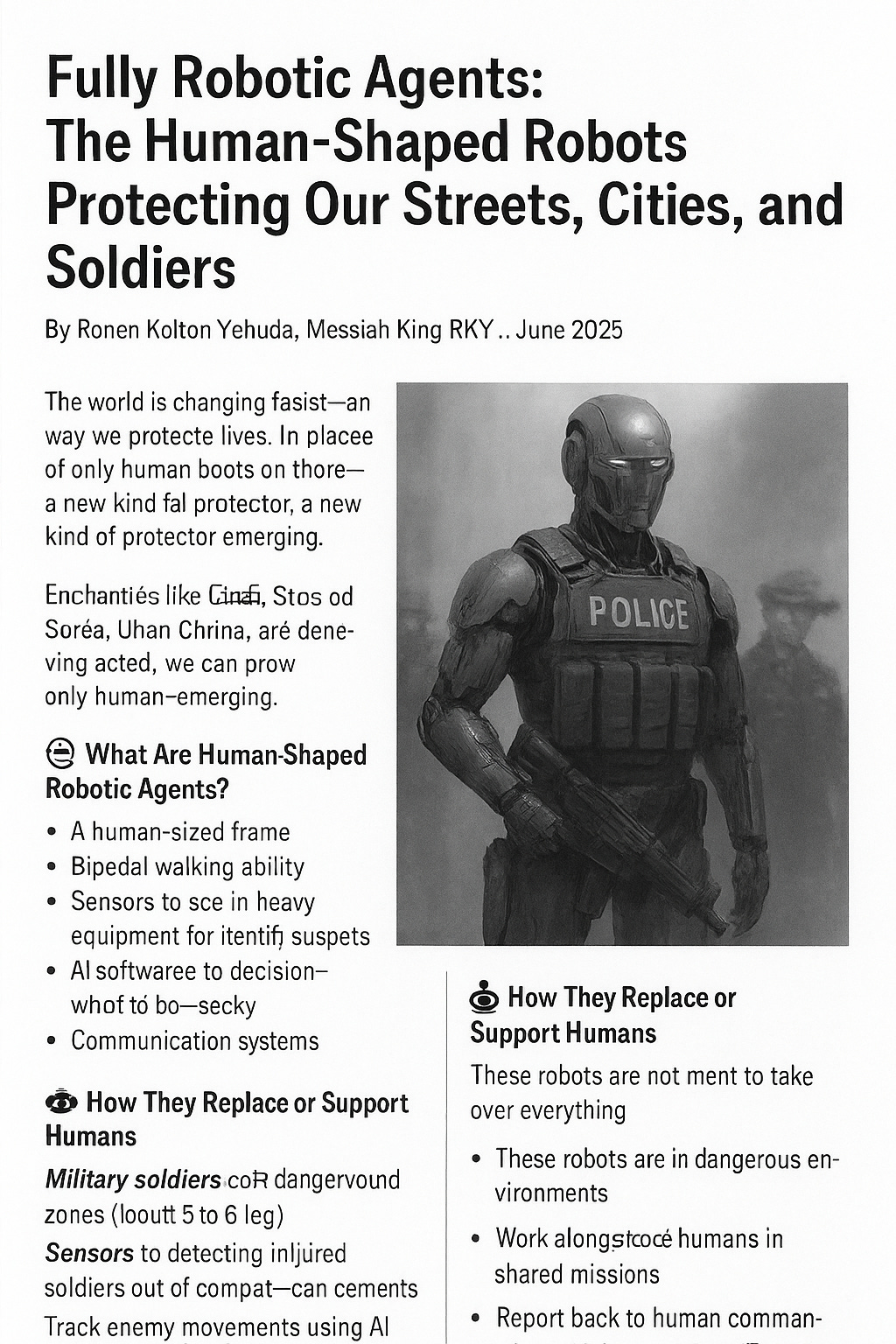
🤖 Fully Robotic Agents: The Human-Shaped Robots Protecting Our Streets, Cities, and Soldiers
By Ronen Kolton Yehuda (Messiah King RKY), June 2025
The world is changing fast—and with it, the way we protect lives. In place of only human boots on the ground, a new kind of protector is emerging: fully robotic agents that walk, talk, and act like humans—but are machines powered by advanced artificial intelligence.
These robots aren’t sci-fi dreams. They already exist. In countries like China, the United States, and South Korea, humanoid robots are being tested to fight fires, assist police, and serve in military missions. Unlike wearable suits or remote drones, these robots are fully autonomous—they can move, see, think, and act on their own.
🤖 What Are Human-Shaped Robotic Agents?
They’re robots that look and move like people. Built with legs, arms, eyes (cameras), and ears (microphones), they are designed to work in the same buildings, vehicles, and streets we do.
Each robot is built with:
A human-sized frame (about 5 to 6 feet tall)
Bipedal walking ability (can walk or run on two legs)
Sensors to see in darkness, hear commands, feel temperature, detect gas leaks, or sense danger
AI software to decide what to do—just like a trained professional
Communication systems to talk with humans and other robots
🛡️ How They Replace or Support Humans
⚔️ Military Robots: Robotic Soldiers
Robotic soldiers can:
Scout dangerous zones before troops arrive
Carry heavy weapons and equipment
Help injured soldiers out of combat
Track enemy movements using AI
Defend perimeters day and night
They follow strict rules and can only use force under human-authorized conditions.
🚓 Police Robots: Law Enforcement Without Risk
In cities, police robots help reduce danger for human officers. They can:
Patrol streets and scan crowds for threats
Use facial recognition to identify suspects
Speak with people and give commands
Subdue violent attackers using non-lethal tools (like tasers or nets)
Record everything they see and hear for legal evidence
Police robots are designed to talk calmly, follow orders, and avoid violence unless absolutely necessary.
🔥 Firefighting Robots: Going Where Humans Can’t
Firefighting robots are some of the most heroic of all. They can:
Walk into burning buildings without getting tired or injured
See through smoke using thermal vision
Search for people trapped under rubble or in toxic environments
Spray water, carry hoses, or move debris
Coordinate with drones and human firefighters
These machines go where it’s too dangerous for any human, especially in chemical spills, wildfires, or collapsed buildings.
🧠 What the AI Actually Does
The brains of these robots are built from AI systems trained on millions of real-world situations. Their job is to:
Understand where they are (navigation)
Identify people, objects, or hazards
Decide the best action in complex environments
Communicate with humans and other robots
Follow ethical rules and mission instructions
If anything seems unsafe or unclear, the robot either stops immediately or asks for human instructions.
🤝 Humans and Robots: Working as a Team
These robots are not meant to take over everything. Instead, they:
Replace humans in dangerous environments
Work alongside humans in shared missions
Report back to human commanders who stay in control
For example:
In a riot, a robot can block a street while human officers handle the crowd
In a fire, the robot can search upstairs while humans rescue from below
In war, robots can guard the perimeter while humans manage strategy
🌍 Already in Use
Countries developing and testing these robots include:
China – humanoid industrial and tactical robots (Fourier, Unitree)
USA – defense robotics from Tesla Optimus, Boston Dynamics, Ghost Robotics
Japan/South Korea – rescue robots, smart firefighter units
Israel and Europe – security robots for airports, stadiums, and critical infrastructure
🔐 Are They Safe?
Yes—if designed correctly. Every robot includes:
Manual override systems (can be shut down remotely)
Ethical programming (no unauthorized violence or privacy violations)
Encrypted data logging (to review any mistake or misuse)
Strict legal boundaries (customized by country or city)
Robots do not "decide" to act on their own outside of instructions. They follow the rules they are given.
🔚 Conclusion
Fully robotic human-shaped agents are no longer the future—they are today’s new frontline. From military zones to burning buildings, from quiet patrols to explosive emergencies, these robots will save lives by going where humans can’t—or shouldn’t.
They’re not here to replace humanity. They’re here to protect it.
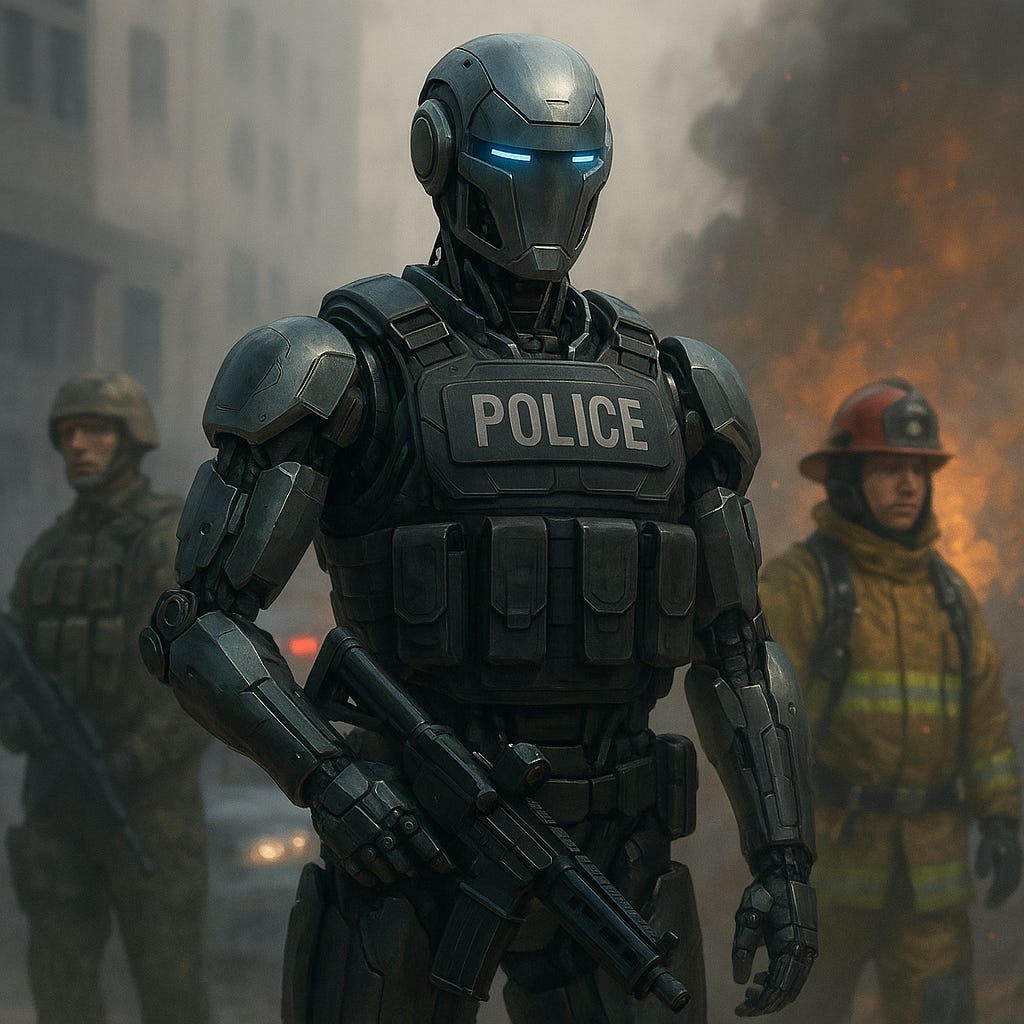
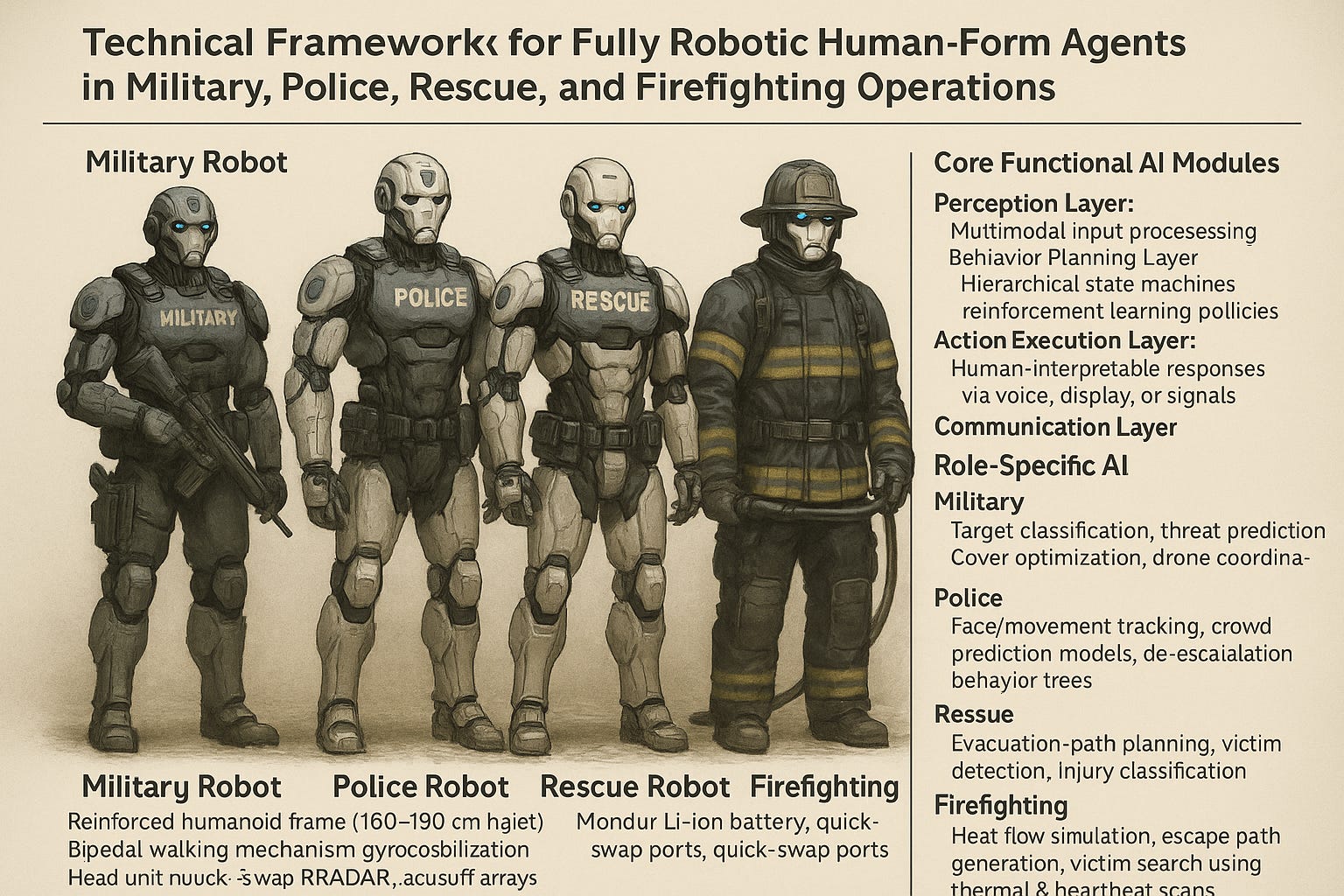
Technical Framework for Fully Robotic Human-Form Agents in Military, Police, Rescue, and Firefighting Operations
By Ronen Kolton Yehuda (Messiah King RKY), June 2025
Abstract
This technical framework outlines the mechanical, computational, and operational systems underpinning fully robotic human-form agents (FRHAs) designed to replace or collaborate with human personnel in military, law enforcement, rescue, and firefighting. It details the hardware architecture, AI control layers, autonomy logic, and role-specific functionalities required for safe and effective deployment.
Introduction
FRHAs are independent, AI-driven robotic agents designed with anthropomorphic structures to operate in human-structured environments. Unlike wearable augmentation systems, FRHAs act autonomously or semi-autonomously using embedded logic, sensor fusion, and real-time command integration. Their form factor allows them to traverse staircases, enter vehicles, manipulate tools, and interact directly with human teams and environments.System Architecture
2.1 Mechanical Composition
Component | Description
--- | ---
Frame | Carbon-titanium composite humanoid chassis (160–190 cm)
Mobility System | Bipedal locomotion with gyroscopic stabilization and optional retractable wheels
Manipulator Arms | Dual 6–8 DOF arms with adaptive gripping, tool slots, and haptic feedback
Protective Shell | Ballistic, fire, and chemical-resistant plating tailored to role
Power Unit | Modular Li-ion or hydrogen fuel cells (3–8 hour runtime)
2.2 Sensor Suite
Sensor Function Vision RGB, IR, and thermal cameras for perception, tracking, and fire/smoke detection LIDAR & RADAR 3D environment mapping, obstacle avoidance, and SLAM Acoustic Arrays Gunshot localization, voice command parsing Gas/Chemical Sensors Hazard detection (e.g., CO, ammonia, radiation) IMU + GPS Internal orientation, navigation, and fall correction
AI and Decision Framework
3.1 Core AI Modules
Perception Layer: Real-time multimodal sensor processing
Behavior Layer: Finite state machines and reinforcement learning agents
Planning Layer: Path planning, risk analysis, task prioritization
Communication Layer: Voice response generation, gesture understanding, network sync
3.2 Role-Based AI Extension
Role Specific AI Functions Military Target ID, tactical modeling, engagement logic, drone swarming Police Facial recognition, behavioral threat prediction, non-lethal force deployment Rescue Victim localization via thermal/heartbeat scan, debris analysis, triage coordination Firefighting Heat flow modeling, collapse prediction, autonomous hose control
Autonomy and Safety
Autonomy Level | Description
--- | ---
L1 | Manual remote operation
L2 | Assisted decision support
L3 | Conditional autonomy with override
L4 | Full mission execution with ethical rule constraints
Safety Features:
Multi-tiered override systems (manual, remote, biometric)
Ethical constraint enforcement via hardcoded logic (Asimov-like laws)
Encrypted event logging for post-mission audit
Communication & Network
Dual-channel comms: 5G/Wi-Fi mesh + fallback LoRa protocols
Encrypted peer-to-peer data sync among FRHAs
Real-time dashboard access for commanders
Vocal/gesture-based human-robot coordination
Role-Specific Capabilities
6.1 Military Deployment
Combat support in high-risk zones
Enemy tracking and designation
Extraction of wounded personnel
6.2 Policing Applications
Patrol in urban environments
Riot control with AI-powered escalation logic
Evidence logging with GDPR compliance
6.3 Rescue Operations
Search and rescue in collapsed structures or disaster zones
Emergency triage stabilization
Autonomous victim evacuation
6.4 Firefighting
Entry into high-heat and chemical environments
Aerial/ground drone coordination
Fire suppression tool management
Maintenance and Upgrades
Component | Cycle | Notes
--- | --- | ---
Joints/Actuators | 500 hrs | Swappable cartridges
Power Units | 1000 cycles | Hot-swappable
Sensors | Self-diagnosing | Replace if >5% calibration drift
AI Core | OTA updates weekly | Ethics, logic, navigation enhancementsCompliance and Legal Considerations
IEEE P7000 and ISO/TC 299 adherence
Lethal Autonomous Weapons Protocol-compliant
Regional rules of engagement logic profiles
Real-time transparency toggles for public deployments
Deployment Strategy
Phase | Description
--- | ---
I | Testing in elite military/police/rescue units
II | Expansion to civil emergency and municipal use
III | Joint deployment with human operators in live zones
IV | Standardization, regulation, international interoperabilityConclusion
FRHAs represent the convergence of humanoid robotics, embedded AI, and mission-specific automation for real-world frontline operations. Their architecture enables them to replace or assist humans in extreme environments without compromising on ethics, control, or situational intelligence. These agents are not just tools—they are operational platforms.
End of Document
Legal Statement for Intellectual Property and Collaboration
Author: Ronen Kolton Yehuda (MKR: Messiah King RKY)
The concept, structure, and written formulation of the Fully Robotic Human-Form Agents (FRHAs) — including their military, police, rescue, and firefighting configurations — are the original innovation and intellectual property of Ronen Kolton Yehuda (MKR: Messiah King RKY).
This statement affirms authorship and creative development of the FRHA system as a unified humanoid robotic framework integrating autonomous AI logic, modular mechanical architecture, sensor fusion, and ethical safety constraints for professional and emergency operations.
The author does not claim ownership over general robotic engineering or scientific principles, but solely over the original invention, system design logic, terminology, and written expression presented in this work.
Any reproduction, adaptation, modification, or commercial development of this invention or its documentation requires the author’s prior written approval.
Academic and journalistic references are permitted when proper credit is given.
The author welcomes lawful collaboration, licensing, and partnership proposals, provided that intellectual property rights, authorship acknowledgment, and ethical technology standards are fully respected.
All rights reserved internationally.
Published by MKR: Messiah King RKY (Ronen Kolton Yehuda)
📘 Blogs:

Also for rescue