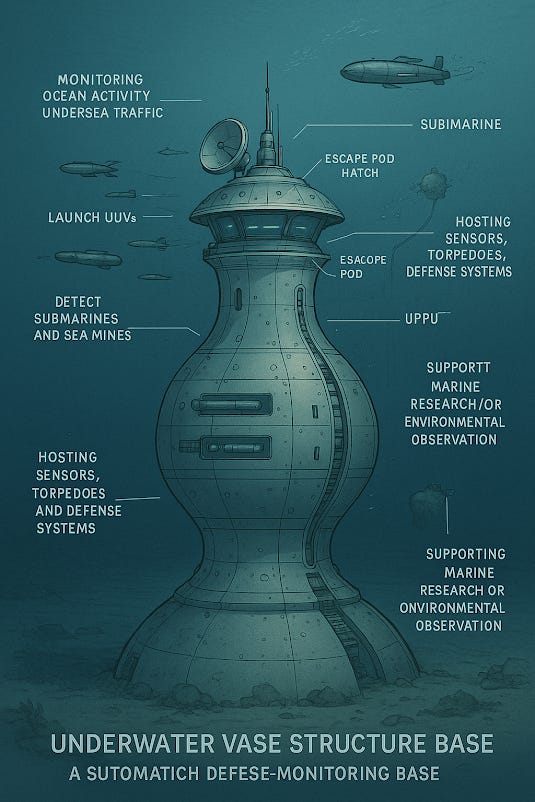
The Underwater Vase: A Bold New Frontier in Ocean Defense and Research

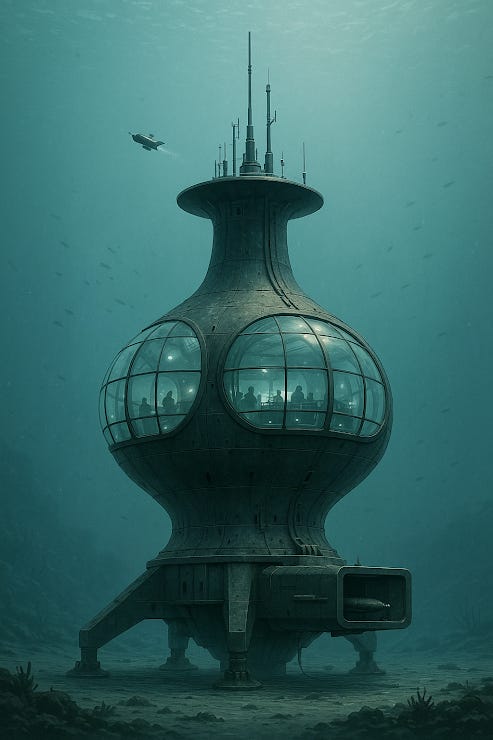
The Underwater Vase: A Bold New Frontier in Ocean Defense and Research
By Ronen Kolton Yehuda (Messiah King RKY)
Introduction
As threats and opportunities continue to emerge from beneath the waves, the concept of ocean-based infrastructure has entered a transformative era. The Vase-Class Underwater Defense Structure, inspired by the timeless geometry of an amphora, is a next-generation deep-sea installation that merges defense, research, surveillance, and emergency response into a single, modular, and scalable system. Designed to rest on the seafloor or operate as a mobile platform, the Vase-Class represents a bold reimagining of underwater presence — stable, stealthy, and smart.
Why a Vase?
The amphora-inspired form is not aesthetic coincidence — it is functionally and structurally optimal for high-pressure marine environments:
Wide Base: Offers anchoring stability and houses power systems, ballast tanks, and seafloor sensors.
Bulbous Midsection: Provides pressurized space for crew, AI command nodes, laboratories, weapon systems, and life support.
Narrow Neck: Minimizes hydrodynamic drag and serves as a vertical transition shaft.
Flared Top: Hosts antennas, drones, communication arrays, and defensive turrets — often with partial elevation toward the surface.
Recent designs include glass domes made from borosilicate-alumina composite, allowing 360° underwater observation for research, mental resilience, and visual command.
Internal Architecture and Functional Zones
1. Foundation (Base Zone)
Self-drilling anchor struts
Ballast tanks and stabilization fins
Ocean current turbines and thermal gradient harvesters
Seafloor seismic, sonar, and temperature sensors
2. Operations & Control Deck
AI-assisted mission control
Tactical and scientific monitoring stations
3D sonar arrays, radar, and satellite uplinks
UAV, UUV, and AUV control interfaces
3. Defense Systems
Vertical Launch Systems (VLS) for torpedoes and anti-air missiles
360° auto-reloading torpedo bays
Laser and railgun interceptors
Acoustic mine dispensers and smart net defenses
4. Living Quarters and Life Support
Algae-based food bioreactors and oxygen recycling
Quarters for 20–80 crew members
Training, exercise, and medical compartments
Escape capsules, shelters, and decompression pods
5. Power and Communication
Modular nuclear micro-reactor (optional)
Ocean energy harvesters
Redundant graphene-based batteries
EMP-shielded data and power grid
Satellite, optical fiber, and acoustic communication systems
Entry, Exit, and Connectivity
Airlocks
Double-sealed, pressure-balanced chambers for crew and equipment.
Dry Docks
Vehicle bays that allow UUVs, drones, or submarines to dock and operate internally after water evacuation.
Submarine-Compatible Transfer Tunnel
Pressurized telescopic tunnel for direct submarine-to-base personnel and cargo transfer.
Vertical Access Shafts
Elevator tubes connecting the base to surface platforms or shoreline control hubs.
Emergency Egress
Escape capsules and internal pressure shelters in case of flooding, attack, or system failure.
Autonomous and Remote Operations
The Vase-Class supports:
Full autonomy via multi-core AI systems
Remote control from floating command ships, land-based centers, or tethered submarines
Hybrid mode, combining onboard crews with remote AI oversight
Autonomous systems manage power flow, sonar scanning, drone deployment, tactical responses, structural health, and environmental monitoring.
AI Nodes Include:
Command AI
Systems AI
Life Support AI
Docking & Mobility AI
Sensor AI (acoustic, thermal, chemical, electromagnetic)
Shoreline Integration (Leshe Model)
The structure is factory-built, transported to a shoreline hub (leshe), then:
Assembled and tested
Floated or lowered into water
Towed or self-navigated to its operational site
Anchored to seafloor or held in semi-submerged position
Optional connection to land includes:
Power and data cables
Air and water pipes
Submarine shuttle or pressurized elevator tubes
The system is reversible: the unit can be retrieved for maintenance or relocation.
Mobile Variant: Submarine-like Deployment
A deployable version of the Vase-Class base includes:
Retractable propulsion pods
Foldable anchoring legs
Pressure-stable hull for movement
Internal ballast control for diving and resurfacing
Compatibility with submarine and drone fleets
This variant allows mobile command, stealth patrols, and disaster deployment.
Use Cases Across Domains
Domain Application Naval Defense Monitoring EEZs, launching drones, detecting submarines Submarine Support Resupply, coordination, intelligence exchange Scientific Research Coral reef analysis, marine biology, seafloor geology Environmental Monitoring Ocean temperature, currents, pollution, seismic activity Emergency Response Rescue base for tsunamis, oil spills, submarine disasters Underwater Tourism Future glass-domed hotels and deep-sea observation zones
Strategic Vision: A Global Network
The Vase-Class is designed for scalability and integration:
Undersea networks of vases linked by tunnels or sonar grids
Regional command chains supported by floating air-sea stations
Autonomous drone fleets coordinated from seafloor to surface
Permanent ocean infrastructure for defense, science, and diplomacy
Conclusion
The Vase-Class Underwater Defense Structure is more than a base — it is a bold step toward a new era of maritime infrastructure. Designed to endure the deep sea and serve multi-domain operations, it unifies security, sustainability, and science. Its elegant geometry, modular design, AI command, and adaptive deployment make it the foundation for the underwater cities, defense systems, and research missions of the future.
The ocean is no longer the last frontier — it is the next domain of sovereign presence. And the Vase-Class is how we rise to meet it.
The Underwater Vase: A Bold New Frontier in Ocean Defense and Research
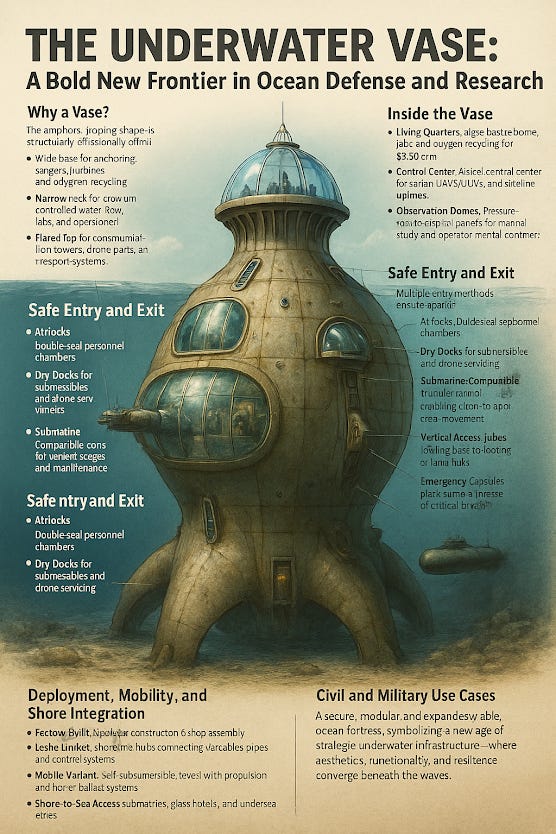
In a time when threats come from land, sky, and sea, a new ocean base design is emerging—one that is powerful, multifunctional, and shaped like an ancient amphora. The Vase-Class Underwater Defense Structure is a seafloor-based installation that integrates defense, research, surveillance, and emergency response within a hardened, modular habitat. Its design has now evolved to include glass domes, expanded interior capacity, and enhanced docking for submarines and drones.
Why a Vase?
The amphora-inspired shape is structurally and functionally optimal:
Wide base for anchoring, sensors, turbines, and stability
Bulbous midsection for crew, control rooms, labs, and operational zones
Narrow neck for controlled water flow and internal transit
Flared top for communication towers, drone ports, and weapon systems
Glass domes now enhance this structure with 360-degree underwater observation, boosting research and psychological comfort.
Inside the Vase
Living Quarters: With full life support, algae-based food systems, and oxygen recycling for 20–80 crew
Control Center: Centralized AI-assisted command for sonar, UAVs/UUVs, and satellite uplinks
Docking Bays: Dry docks and direct submarine docking for vehicle access and maintenance
Observation Domes: Pressure-resistant glass panels for marine study and operator mental wellness
Power Systems: Modular reactors, thermal gradient harvesters, and ocean current turbines
Safe Entry and Exit
Multiple entry methods ensure operational flexibility and safety:
Airlocks: Double-seal personnel chambers
Dry Docks: For submersibles and drone servicing
Submarine-Compatible Transfer Tunnel: Telescopic, pressure-equalized corridor enabling door-to-door crew movement
Vertical Access Tubes: Linking base to floating or land hubs
Emergency Capsules: Eject upward in case of critical breach
Defense and Monitoring Systems
VLS tubes, torpedo launchers, laser/railgun turrets
AI-enhanced sonar arrays, passive listening, electromagnetic anomaly sensors
Mine dispensers, acoustic net defenses
Command-AI redundancy, EMP-shielded grid, blast doors, sealing redundancy
Deployment, Mobility, and Shore Integration
Factory-Built: Modular construction and shop assembly
Leshe-Linked: Shoreline hubs connect to structure via cables, pipes, and control systems
Mobile Variant: Self-submersible, recoverable vessel with propulsion and hover-ballast systems
Shore-to-Sea Access: Submarines, vertical shafts, or tethered shuttle docks ensure logistical integration
Civil and Military Use Cases
Strategic defense of choke points and exclusive economic zones (EEZs)
Host for autonomous underwater vehicles (AUVs), unmanned drones, and rescue ops
Platform for marine biology, seismic monitoring, and climate research
Emergency response node for oil spills, earthquakes, or submarine recovery
Visionary use: tourism, glass hotels, and undersea cities
Strategic Future
The Vase-Class structure is a secure, modular, and expandable ocean fortress. Whether protecting borders, exploring marine frontiers, or preparing for disaster response, it symbolizes a new age of strategic underwater infrastructure—where aesthetics, functionality, and resilience converge beneath the waves.
The Underwater Vase: A Bold New Frontier in Ocean Defense and ResearchNow with Glass Domes and Expanded Space for Life and Mission Control
In a time when threats come not only from land and sky but also from beneath the waves, a new type of ocean base is emerging — one that is as powerful as it is unusual in shape. Imagine a huge structure on the seafloor that looks like an ancient amphora or vase. But instead of holding water, this one holds crew members, sensors, drones, and advanced defense systems. This is the Vase-Class Underwater Defense Structure — a giant, high-tech base that rests quietly at the bottom of the sea, watching, listening, and protecting.
And now, it's getting bigger, smarter, and more transparent — literally. The newest version includes glass domes, larger interior sections, and new ways for people and machines to enter and exit safely.
Why a Vase?
The idea of shaping an underwater base like a vase may sound strange at first. But the design is based on practical reasons:
A wide base keeps the structure stable on the ocean floor and allows for anchors, sensors, and power systems.
A curved middle section gives room for people to live and work inside — including control rooms, labs, and sleeping quarters.
A narrow neck improves water flow and creates a protected shaft for moving between levels.
A flared top allows antennas, drone ports, and defense systems to be placed above the main body of the vase — where they’re less likely to be damaged or seen.
Now, with added glass panels and domes, the structure also includes observation decks where crew members can see outside, study marine life, or monitor nearby activity — all from behind thick, pressure-resistant glass.
What Happens Inside?
Inside the vase are different zones for different purposes:
Living Quarters: Crew members can live inside for weeks or months. There are kitchens, sleeping areas, exercise rooms, and even algae gardens for food and oxygen recycling.
Control Center: The heart of the vase — where operators monitor sonar, communicate with the surface, and control underwater drones or defense systems.
Drone & Submarine Garage: Underwater vehicles can enter the vase through a dry dock. Once inside, water is drained out, and the vehicles can be refueled or repaired.
Observation Domes: The new glass areas provide 360-degree views of the ocean, useful for both research and mental health.
Power Room: The vase can use nuclear micro-reactors, ocean currents, or even underwater temperature differences to generate electricity.
Safe Entry and Exit
One of the most important parts of any underwater structure is making sure people and machines can get in and out without letting water flood the base.
The vase solves this with:
Airlocks: Double-door chambers that drain water and balance pressure before anyone enters the main base.
Dry Dock Bays: Large docking rooms that allow drones or small submarines to enter, be sealed off, and then worked on in dry conditions.
Vertical Shafts: A long tunnel can connect the vase to a floating platform or a land base. This can be used for crew transfer, cargo, or emergency evacuation.
Why Build It?
The vase isn’t just a cool idea — it’s a real solution for real needs. Here are a few examples of what it can do:
Defense: It can detect submarines, launch torpedoes, or monitor borders silently from underwater.
Surveillance: With sonar and satellite links, it can track movement across oceans, support nearby ships, and collect intelligence.
Research: It can host scientists studying coral reefs, marine animals, or underwater volcanoes.
Disaster Response: In case of oil spills, earthquakes, or missing submarines, it can act as a base for rescue drones and communication.
Land-to-Sea Connection
The vase is not built at sea. It’s made in large parts in a factory — then transported to a shoreline hub (called a leshe), where it’s launched into the water like a ship. From there, it can be:
Towed or self-driven to its final location
Anchored to the seafloor using retractable legs
Connected to land by cables, pipes, or shuttle submarines
Returned to shore for repairs or upgrades if needed
This makes the vase modular and reusable — like a giant plug-and-play ocean station.
A Look into the Future
The Vase-Class structure represents a big step forward in how we use the ocean — not just for war or defense, but for science, sustainability, and safety. Its glass domes let us see the sea like never before. Its technology allows for full-time deep-sea missions. And its shape — both ancient and futuristic — reminds us that design can be both beautiful and practical.
In the future, underwater vases may line strategic straits, protect islands, monitor sea traffic, and even welcome tourists in glass-walled hotels under the waves. Whether for defense, discovery, or diplomacy — the underwater vase is ready.
The Underwater Vase-Class Structure: Autonomous and Remote-Controlled Deep-Sea Infrastructure
Introduction
The Vase-Class Underwater Defense Structure is more than a physical installation on the seafloor — it is an intelligent, networked, and optionally autonomous system capable of operating with or without onboard personnel. As threats evolve and oceans become contested arenas for defense, research, and environmental surveillance, the ability to remotely operate and automate deep-sea bases becomes a critical advantage. This article explores how the Vase-Class system integrates remote control, full AI autonomy, semi-autonomous mission profiles, and fail-safe manual override systems.
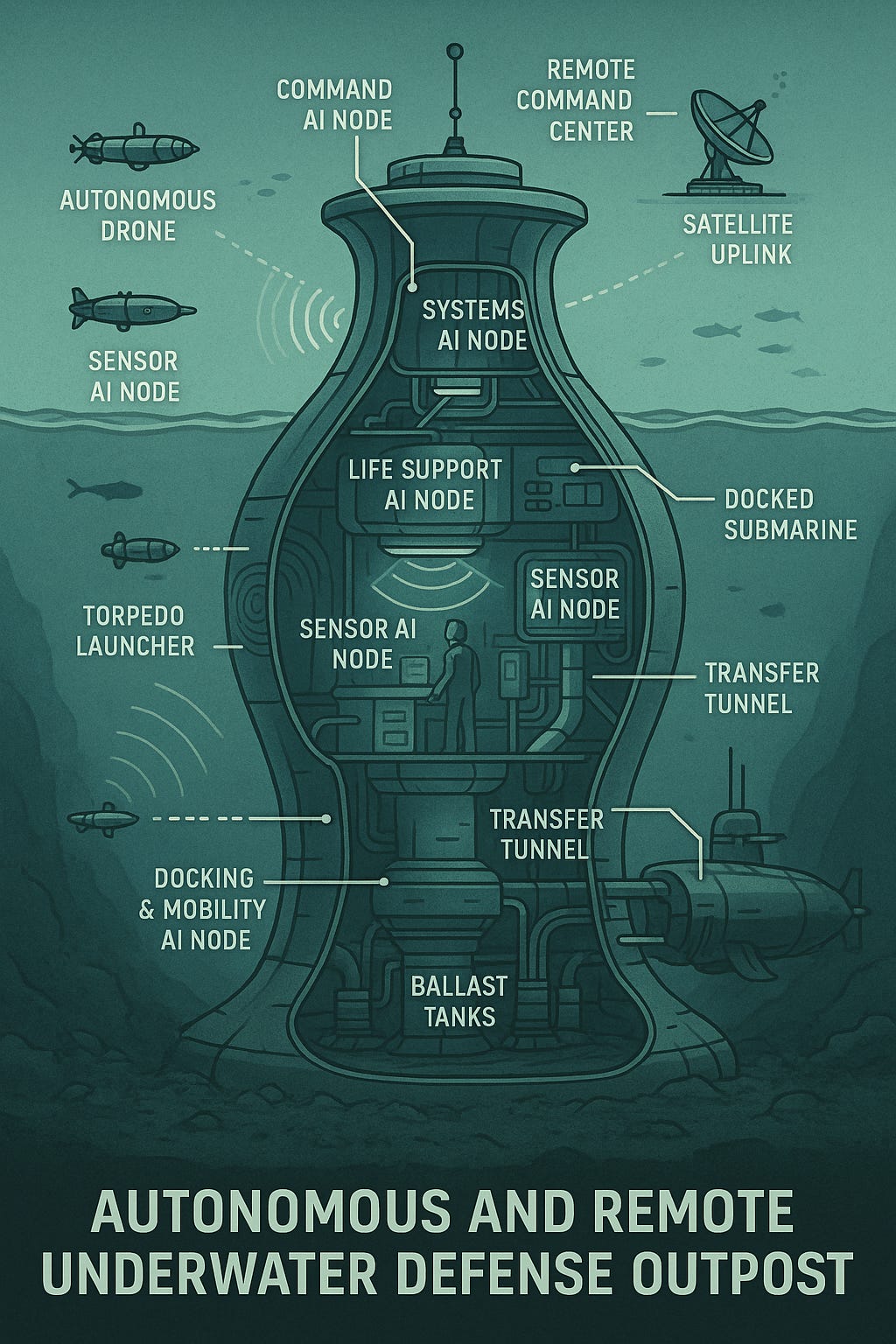
1. Remote and Autonomous Operation: Overview
The Vase-Class structure can be operated in three modes:
Fully Autonomous Mode
All mission protocols are handled by onboard AI systems, including surveillance, threat response, environmental monitoring, and energy management.Remote-Controlled Mode
The base is operated in real-time from a command center on land, aboard ships, or from satellite-linked control hubs. Human operators guide strategic decisions while the system handles routine tasks.Hybrid Mode
The base runs autonomously with remote human oversight and the option for manual intervention in complex or critical scenarios.
2. Central AI System ("Vase-AI")
Features:
Mission Management: Monitors and prioritizes objectives across defense, surveillance, and research domains
Threat Assessment Engine: Uses pattern recognition and anomaly detection to assess sonar, electromagnetic, and visual data
Behavioral Logic: Can simulate crew decision trees to manage emergencies, scientific protocols, or defense escalation
Machine Learning Module: Continuously adapts to terrain, ocean conditions, and adversary tactics
Security:
Encrypted communication channels
EMP-hardened core processors
Redundant backup nodes with air-gapped integrity
Ethical override based on preset international maritime protocols
3. Remote Command and Monitoring
Command Interfaces:
Shore-based command facilities (military or research)
Satellite-linked mobile command stations (airborne or naval)
UAV relay systems for ocean-based temporary uplinks
Functions Available Remotely:
Activate/deactivate sensors, weapons, or drones
Control power systems and life support
Launch or recall autonomous underwater vehicles (AUVs)
Override base AI in emergencies
Initiate seal-off protocols or remote evacuation
4. Communication and Data Exchange
Systems:
Satellite Uplink Towers: Extendable masts or buoy-linked dishes
Undersea Fiber Optics: For fixed regional networks or tethered installations
UAV Relay Drones: Mobile aerial links launched from the canopy
Quantum-Encrypted Channels: For top-level military use
Low-Frequency Acoustic Modems: For deep-sea, long-range backup signals
Redundancy and Resilience:
Every system has a duplicate channel
Autonomy continues even if disconnected
Data is stored in tamper-proof black-box systems
5. Autonomous Mission Scenarios
Scenario Autonomous Tasks
Military Surveillance Continuous sonar sweep, enemy detection, alert protocols
Environmental Research Sample collection via ROVs, data logging, climate tracking
Disaster Response Tsunami/seismic event detection, auto-deploy drones
Hostile Encounter Auto-lock on targets, warn or engage based on ROE
Resupply Coordination Receive supply submarines, auto-dock, transfer payloads
6. Redundancy and Safety Systems
Triple-Failover Command Logic: Ensures base never enters rogue state
Biometric Lockouts: Remote override requires multilayered authentication
Auto-Isolation: In case of cyber intrusion or sabotage, segments shut off independently
Manual Override Ports: Accessible only from reinforced interior control rooms or by authorized submarine docking
7. Scaled Network Operations
Multiple Vase-Class units can be deployed as an interlinked Undersea Grid, managed by a central AI or coordinated human-AI command:
Shared sonar and monitoring fields
Autonomous handoff of drones or surveillance responsibilities
Adaptive swarm behavior (e.g., shifting energy load or sharing sensor inputs)
Support for "Underwater Highway Nodes" in deep-sea traffic and logistics
8. Future Prospects
Integration with Naval Combat Clouds: Bases will join a real-time, distributed maritime defense network
Fleet Coordination: Manage swarms of AUVs, UUVs, and smart mines
Smart Habitats: Act as hubs for underwater cities or hotels — monitored and serviced entirely by AI
Civilian Applications: Autonomous environmental monitoring for governments, NGOs, or universities
Conclusion
The Vase-Class Underwater Structure is more than a defense base — it is a living, thinking infrastructure node. With full autonomous capabilities, advanced remote control, and secure AI mission management, it can function independently in the ocean’s most hostile environments. In the age of underwater competition, disaster response, and planetary monitoring, autonomous and remotely managed ocean architecture is not just an advantage — it’s essential.
Author:
Ronen Kolton Yehuda (Messiah King RKY)
Visionary Strategist | Defense Technologist | Creator of the Vase-Class System
Certainly. Below is a technical article focusing on the autonomous and remote operation capabilities of the Vase-Class Underwater Defense Structure, integrated into the broader defense and research architecture of the system.
Autonomous and Remote Operation Framework for the Vase-Class Underwater Defense Structure
Technical Systems Architecture and AI-Controlled Mission Profiles
Abstract
The Vase-Class Underwater Defense Structure, designed for seafloor deployment, is equipped with full-spectrum autonomous capabilities and remote-control interfaces for military, scientific, and emergency operations. This paper details the embedded control architecture, operational AI layers, telemetry infrastructure, mission adaptability, and security protocols that enable remote and unmanned operation in high-risk oceanic environments.
1. Introduction
Underwater bases face a unique triad of challenges: environmental isolation, communication latency, and risk of manned exposure. The Vase-Class architecture addresses these through integrated autonomous systems, allowing for fully unmanned operation, semi-supervised remote control, and hybrid deployment strategies.
This capability is essential for strategic defense zones, high-pressure research environments, and deep-sea disaster response, where human presence is constrained or unnecessary.
2. Command Modalities
Mode Description Use Case Manual-Crewed Onboard crew controls all systems; AI assists Long-term research, full tactical command presence Semi-Autonomous AI controls subsystems; remote command center oversees high-level decisions Low-risk zones, standard surveillance Fully Autonomous Entire base runs via embedded AI with autonomous mission execution High-risk zones, stealth surveillance, deep-sea deployments
3. AI Control Architecture
3.1 Core AI Nodes
The Vase-Class is powered by a distributed AI cluster, with fault-tolerant nodes assigned per operational domain:
Command AI Node: Strategic decision-making, threat response, drone deployment
Systems AI Node: Power regulation, structural integrity, ballast management
Life Support AI Node: Oxygen cycling, thermal regulation, bioreactor control
Sensor AI Node: Acoustic, thermal, chemical, and electromagnetic data analysis
Docking & Mobility AI Node: Submarine docking, drone bay operations, self-submersion
All AI modules operate under a central mission kernel, protected by quantum-encrypted firmware and an EMP-shielded operating grid.
3.2 Autonomy Features
Predictive failure detection using machine-learning telemetry analysis
Dynamic energy reallocation (e.g., diverting power during stealth or combat)
Adaptive mission switching: defense → rescue → observation
Autonomous drone swarm coordination for external monitoring
4. Remote Operation Infrastructure
4.1 Communication Protocols
Primary: Encrypted satellite uplink (optical/microwave hybrid)
Secondary: Fiber-optic tether to floating or coastal control stations
Tertiary: Acoustic modulation (low-bandwidth fallback for long-range)
4.2 Remote Interface Capabilities
Full control of sensors, drones, weapons, and AI mission states
Real-time diagnostics and failure alerts
3D virtual twin interface for off-site inspection and simulation
Emergency command override with dead-man switch functionality
4.3 Control Center Integration
Land-based command hubs (leshe)
Naval fleet interface terminals
Submarine-linked command bridges with tunnel or wireless access
5. Redundancy and Cybersecurity
5.1 System Redundancy
Triple-redundant power buses
Isolated fallback AI nodes in hardened core
Blast-sealed server vault with automatic locking on breach
5.2 Security Measures
Quantum-key encryption on all control channels
Intrusion detection algorithms in firmware and uplink nodes
Physical kill-switch for remote deactivation (AI-locked unless authorized)
6. Operational Scenarios
Scenario Autonomous Action Remote Role Torpedo Threat Detected AI activates sonar jamming, deploys countermeasures Remote HQ notified, override possible Submarine Docking Request AI verifies ID, extends transfer tunnel Remote confirms authentication logs Deep-Sea Survey AI dispatches drones, collects samples Remote receives and analyzes real-time data System Breach / Flooding AI isolates compartments, auto-seals blast doors Remote monitors interior cam feeds
7. Integration with Mobile Units and Networks
The Vase-Class structure can network with:
Mobile submarine fleets: direct docking and data exchange
Underwater drone swarms: remote coordination for mapping and defense
Other vase units: interlinked via sonar mesh or fiber cables for regional command
Floating air-sea command bases: full uplink via vertical access tubes or relay buoys
8. Maintenance and Diagnostics
Continuous AI-driven system integrity checks
Remote firmware updates and subsystem patching
Predictive diagnostics for propulsion units, seals, and reactors
Robotic arm maintenance available in mobile variants
9. Conclusion
The autonomous and remotely operated design of the Vase-Class Underwater Defense Structure enables it to function as a next-generation seafloor outpost — capable of strategic autonomy, real-time remote control, and resilient mission execution without surface dependency. As underwater operations grow in complexity, these intelligent architectures will become the standard for both defense and scientific infrastructure on the ocean floor.
Author:
Ronen Kolton Yehuda (Messiah King RKY)
Defense Technologist | Strategic Systems Architect | Founder of the Vase-Class Concept
Let me know if you'd like a companion schematic, system diagram, or visual concept layout.

Vase-Class Underwater Defense Structure
Overview
The Vase-Class structure is a multi-functional, vertically integrated underwater base shaped like a vase. Designed to be anchored on the seafloor, it serves as a:
Naval defense outpost
Surveillance and monitoring station
Docking hub for submersibles and drones
Launch platform for unmanned vehicles and torpedoes
Communication and data relay node
Research and disaster response base
Structural Design
Shape:
Wide base: For anchoring and stability
Narrow neck: For pressure and flow control
Bulbous midsection: For primary operations and living quarters
Flared top: For communication antennas and drone ports
Materials:
Reinforced submarine-grade titanium alloy and composite ceramics
Internal pressure-compensated chambers
Algae-repellent and stealth coating
Core Functional Zones
1. Foundation (Base)
Deep-sea anchor system with self-drilling piles
Anti-mining defense grid
Power storage, ballast tanks, and emergency buoyancy system
Seafloor sensor arrays (seismic, sonar, thermal)
2. Operations & Control Deck (Midsection)
Command center with tactical interface
Real-time 3D sonar and radar mapping
Satellite uplink and encrypted naval communications
Autonomous vehicle bay (UUV, AUV, ROV)
3. Defense Systems
Torpedo launcher bays (360° azimuth)
Vertical launch system (VLS) tubes for anti-ship and air-defense missiles
Laser/interception turrets for incoming threats
Mine deployment and net defense
4. Monitoring and Surveillance Suite
Long-range sonar arrays
Acoustic signature detection systems
AI-enhanced threat detection
Marine traffic analysis systems
Satellite and surface relay towers
5. Human Occupancy & Logistics
Crew quarters for 20–60 personnel
Emergency evacuation pods and escape hatch system
Oxygen recycling, freshwater generation
Food, energy, and waste recycling system
Labs for biology, defense R&D, and marine science
Power System
Hybrid energy:
Nuclear mini-reactor (optional)
Ocean current turbines
Tidal & thermal gradient harvesters
Backup battery arrays
Redundant power network with EMP shielding
Optional Modules
Drone Swarm Launch Dome
Floating surface platform with vertical elevator tube
Mini-submarine docking garage
Underwater tunnel connectors to nearby vases
Decoy & camouflage cloak systems
Use Cases
Naval choke point defense
Strategic deterrent in EEZ waters
Undersea intelligence gathering
Anti-submarine warfare (ASW) base
Marine environment monitoring station
Disaster response hub for oil spills, tsunamis
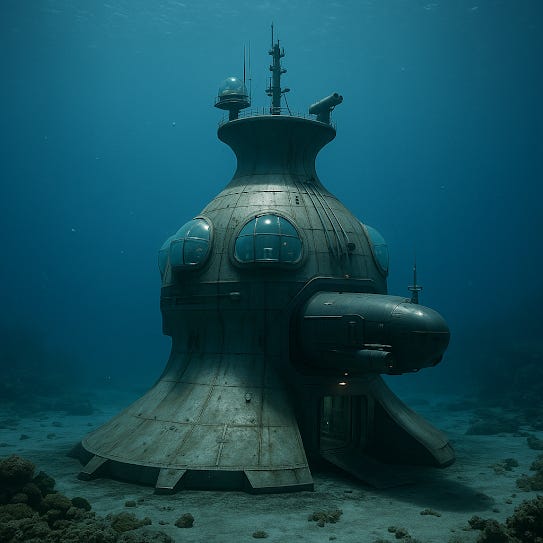
Vase-Class Underwater Defense Structure: A Technical Overview
Abstract
The Vase-Class Underwater Defense Structure is a modular, seafloor-anchored installation designed for multi-domain maritime operations. Drawing from hydrodynamic and structural principles inspired by amphora-shaped geometry, it integrates surveillance, combat readiness, autonomous systems, and scientific capability within a hardened subaqueous vessel. This paper outlines its architectural design, operational components, and use cases in modern naval strategy.
1. Introduction
As naval threats evolve to include submarines, unmanned vehicles, and stealth incursions, coastal and strategic underwater infrastructure becomes a critical asset. The Vase-Class structure offers a compact, camouflaged, and resilient solution deployable in territorial waters, strategic choke points, or undersea economic zones. Its amphora-inspired shape enables optimal stability, hydrodynamics, and compartmentalization.
2. Structural Design
2.1 Geometric Configuration
Base: Wide-bottom, embedded in seabed via self-anchoring drill piles and weighted ballast rings.
Midsection: Pressurized cylindrical habitat ring with integrated control and life-support systems.
Neck: Vertical shaft for access tunnels, communications towers, and airlock systems.
Top Dome: Antenna arrays, drone hatches, and laser/sonar ports.
This configuration ensures both minimal drag and maximal volumetric use within a pressure-resistant form factor.
2.2 Materials
Titanium-alloy exostructure (Grade 5 or 23)
Carbon composite pressure hulls (with ceramic-reinforced armor plating)
Internal anti-vibration mounting for electronics and life support
Acoustic-dampening outer layer for stealth
3. Systems and Subsystems
3.1 Power Supply
Hybrid propulsion and energy system:
Ocean current turbines integrated into anchor struts
Thermal gradient generators
Nuclear micro-reactor (optional for permanent installations)
Solar buoys (surface-linked backup)
3.2 Life Support and Habitability
Pressurized crew quarters (supporting 10–60 personnel)
Modular life support with oxygen generation, CO₂ scrubbing, and freshwater distillation
Food storage and algae-based nutritional recycling unit
Emergency evacuation pods and upward-launch escape capsules
3.3 Surveillance and Monitoring
Passive and active sonar arrays with 360° coverage
AI-enhanced acoustic signature analysis
Thermal and chemical sensors for enemy detection and environment tracking
Satellite uplink and encrypted communication relay towers (via periscope or buoy)
3.4 Defense Systems
Vertical Launch System (VLS) for underwater and anti-air missiles
Torpedo bay with smart reload system
Laser and railgun mounts (surface or semi-surface dome)
Underwater mine deployment and acoustic net defenses
3.5 Docking and Deployment
2–6 vehicle docking bays (UUVs, AUVs, crewed minisubs)
External robotic arms for hull maintenance, cable deployment, or salvage
Upper hatch platform for UAV or USV operations
4. Use Scenarios
Scenario Type Function
Military Surveillance Long-term monitoring of hostile or contested maritime zones
Territorial Defense Enforcing maritime sovereignty with real-time tracking and deterrence
Choke Point Control Securing straits and canals from underwater incursions or smuggling
Submarine Support Station Providing recharging, rearming, or coordination for submarine fleets
Disaster Recovery Node Hosting rescue drones, seismic sensors, or emergency payload delivery
Environmental Monitoring Observing coral reefs, currents, and climate metrics in real-time
Dual-Use Scientific Module Conducting deep-sea biology, AI hydrography, or strategic mineral studies
5. Deployment & Scalability
The Vase-Class unit is modular and may be:
Standalone
Networked via underwater tunnels or wireless relays
Integrated into larger underwater cities or defense networks
Deployment requires a pre-surveyed anchor zone, transported via heavy-lift submersible or semi-submerged platform, followed by autonomous or crewed positioning, drilling, and activation.
6. Conclusion
The Vase-Class Underwater Defense Structure represents a transformative paradigm in underwater military infrastructure — merging stealth, survivability, autonomous systems, and multi-role capacity. In future conflicts and maritime stability operations, such deep-sea assets will serve not only as defense posts but as strategic command, research, and sustainability nodes across the ocean floor.
Entering the Underwater Vase: How Crews Access and Stay Dry in a Deep-Sea Defense Structure
Underwater defense bases like the “vase-class” structure operate under extreme pressure, surrounded by water at all times. One of the biggest engineering challenges is how to enter or exit the base without letting water in, and how to move personnel, drones, or submarines in and out safely.
This article explains the solutions and technologies that allow safe access to the underwater structure.

1. The Challenge: Pressure and Sealing
At depths of 100 to 300 meters (or more), the surrounding water pressure is immense — and any breach or opening would cause flooding, danger, or complete system failure. Therefore, all entry points must be:
Completely sealed when not in use
Pressure-balanced when in operation
Able to handle emergency exits or rescue missions
2. Main Entry Systems
🔸 Airlock Chambers (Personnel Entry)
Located at the top or lower neck of the vase
Includes a double-door system:
Outer door opens to the water
Inner door opens to the dry base
When a person or drone enters, the chamber is sealed, and water is drained using powerful pumps.
After pressure equalization, the inner door opens safely into the main structure.
Materials: Titanium-alloy with carbon fiber composite seals
Features: Emergency oxygen supply, lighting, internal cameras, and biometric scanners
🔸 Dry Dock Bay (For Vehicles or Drones)
A large interior submersible garage where underwater vehicles (UUVs, minisubs) can dock
Entry via a retractable pressure door
Once a drone enters, the area is sealed, water is pumped out, and maintenance can begin
Common Systems:
Hydraulically sealed docking gate
AI-assisted docking guidance system
Pressure equalization before opening internal doors
3. Top Entry – Vertical Access Tube
Some vase structures are connected by a vertical tube to a floating platform or sea buoy
A pressurized elevator or tunnel connects surface personnel or cargo directly to the base
This tube has multiple seal points, allowing it to isolate and handle pressure at different levels
4. Waterproofing and Sealing Technologies
Electromagnetic sealing rings: React instantly to pressure changes and auto-lock
Self-healing polymer gaskets: Expand and seal micro-cracks when exposed to water
Redundant bulkheads: Multiple doors or plates to prevent total failure if one seal is compromised
5. Emergency Systems
In case of a critical breach:
Auto-closing blast doors segment the structure
Emergency ballast systems allow quick surfacing of top modules
Personal escape pods eject through upward hatches and rise to the surface automatically
Pressure shelters are built into lower levels for safe waiting
6. Surface or Tethered Entry (Optional for Shallow Zones)
For structures in shallow waters (20–50 meters):
Divers or submarines can enter through a wet deck hatch
These hatches are mechanically or magnetically sealed
Designed for frequent personnel movement in calm zones
7. Redundancy and AI Control
All access systems are controlled by a central AI that:
Monitors pressure, water intrusion, and door status
Prevents human error by locking incompatible doors
Responds instantly to breaches or unauthorized access
Conclusion
Accessing a deep underwater base may sound like science fiction, but it’s very real — using airlocks, dry docks, vertical shafts, and advanced sealing systems, modern engineering can make it as safe as any spacecraft or submarine. The “vase-class” underwater defense station combines traditional submarine logic with permanent, stable architecture, providing secure and dry entry points in the most hostile environment on Earth: the deep sea.
Submarine-Compatible Entry System for Vase-Class Underwater Structures
Direct Docking Architecture for Secure Undersea Personnel and Cargo Transfer
Abstract
This paper presents an advanced entry system integrated into the Vase-Class Underwater Defense Structure, enabling direct docking of submarines or submersible vehicles through a sealed, modular hatch interface. This architecture allows door-to-door movement without exposure to water or pressure differentials—facilitating high-speed, stealthy, and secure operations. The system supports rapid deployment, resupply, and personnel transfer under deep-sea conditions and extends the functionality of the underwater base for defense, intelligence, and logistics.

1. Introduction
As underwater infrastructure expands, secure and efficient transfer of personnel, equipment, and data between mobile and static underwater assets becomes critical. Traditional airlocks and dry docks are effective but time-consuming and limited in emergency responsiveness. This new interface allows submarines or minisubs to dock and connect directly to the vase’s hull through a unified docking collar, achieving a pressurized corridor link, akin to jet-bridge boarding in aerospace contexts.
2. Docking Interface Architecture
2.1 External Submarine Docking Collar
Location: Midsection or lower side of the vase structure
Design:
Universal mating ring (UMR) compatible with NATO-standard submarine docking ports
Hydraulic locking clamps for rigid connection under variable current
Sensor-guided alignment system with AI-assisted docking (visual + acoustic beacons)
2.2 Sealed Transfer Tunnel
Expandable transfer tunnel (telescopic or accordion-style)
Built from reinforced pressure-rated composite with magnetic ring seals
Pressurization-controlled tunnel equalizes vessel and base atmosphere
Fully walkable width (~1.2–1.6 m internal diameter) with handrails and lighting
3. Internal Access Module
3.1 Submarine Entry Door
Airlock-integrated submarine side hatch remains sealed until docking is complete
High-strength bi-directional locking system allows initiation from either side
Interior equipped with biometric ID system, decontamination mist, and emergency shut-off valves
3.2 Base Entry Port
Located at the crew logistics zone of the vase
Triple-seal magnetically latched inner hatch
Auto-sealing bulkheads in case of breach or disconnect failure
4. Safety Systems and Redundancy
System Function
Redundant Magnetic Seals Ensure airtight integrity even under minor pressure shifts
Pressure Monitoring Chambers Constant differential sensors with automated valve control
Emergency Cut-off Gates Blast-resistant sliding plates that can isolate the corridor in under 1.2 seconds
Buoyant Detachment Protocol If the submarine loses power, the interface detaches safely and reseals both ends
Manual Override Mechanical release and manual lockout valves in case of AI or power failure
5. Use Scenarios and Benefits
Use Case Description
Stealth Personnel Deployment Deliver special forces directly into the vase base via submarine
Medical Evacuation Transfer injured crew to a recovery submarine without exposing them to pressure changes
Resupply Send vital equipment and rations using dedicated supply minisubs
Rapid Redeployment Evacuate personnel from the vase in the event of imminent threat
Data & Intel Transfer Use encrypted physical data relays via submarine (no surface link required)
6. Integration with Mobile Vase-Class Units
Mobile versions of the vase structure (with propulsion) can rendezvous with a submarine mid-mission. The hydrodynamic profile of the vase allows semi-drift alignment while dynamic positioning thrusters assist with stable side-by-side locking.
In these versions:
The transfer collar is retractable
It can switch between submarine docking and dry dock entry
It includes a magnetic alignment rail system to pull the vessels together for final locking
7. Materials and Engineering
Docking Collar: Titanium Grade 5 with smart-alloy impact dampening
Tunnel Housing: Carbon-borosilicate composite with high tensile resilience
Seals: Multi-layered polymer-metallic magnetic gasket rings
Interior Tunnel Shell: Anti-fog, anti-bacterial laminate with integrated LED lighting
Power & Data Transfer Ports: Optical and conductive ports for shared systems (e.g. refueling or file upload)
8. Deployment and Maintenance
The submarine docking system is built modularly and can be upgraded in port
Routine maintenance includes seal integrity testing, sensor recalibration, and pressure test simulations
Docking logs are automatically recorded for both the vase AI and the submarine’s control systems
9. Conclusion
The submarine-compatible docking module for the Vase-Class Underwater Structure introduces a new standard for undersea logistics, defense mobility, and mission efficiency. By enabling direct, sealed, and fast door-to-door connectivity, it minimizes vulnerability, maximizes operational flexibility, and supports diverse scenarios ranging from covert military ops to humanitarian rescue missions. As underwater infrastructure becomes increasingly critical, such modular and mobile interfacing will shape the next frontier of subsea architecture.

Mobile Vase-Class Structure: A Submarine-Like, Deployable Underwater Base
In the future of maritime defense and exploration, mobility is as important as stability. Enter the mobile vase-class underwater structure — a hybrid design that combines the portability of a submarine, the functionality of a seafloor base, and the modular architecture of a land-to-sea platform.
This structure is built to launch from land or port, carry personnel and equipment, travel across the sea, and deploy underwater — either temporarily or permanently.
1. Design Concept: Submersible, Deployable, and Reversible
The mobile vase-class structure is:

Shaped like a vase or amphora for optimal stability and internal volume
Capable of being transported over land or by ship
Self-submersible — it can dive, anchor to the seafloor, and stabilize
Capable of resurfacing and returning to port for repair, resupply, or reassignment
This makes it ideal for:
Rapid deployment in a conflict or disaster
Temporary underwater operations
Mobile surveillance or research missions
2. Transportation and Deployment
🔸 On Land
Transported on heavy wheeled trailers or rail platforms
Loaded with crew, supplies, and autonomous systems
Maintains internal pressure during transit
🔸 At Sea
Floats like a heavy, self-balanced barge or semi-submersible vessel
Moves using low-speed propulsion pods or can be towed
Equipped with stabilization fins and GPS guidance
🔸 Submersion Process
Anchors at selected site
Ballast tanks fill to submerge the structure
Propulsion modules guide descent
Anchoring struts deploy into seafloor
Stabilization systems activate
Result: The structure becomes a secure, unmoving seafloor base.
3. Features and Systems
🧷 Dual-Mode Pressure Hull
Handles both travel and deep-sea conditions
Self-sealing, anti-corrosion titanium composite
⚙️ Retractable Propulsion and Landing Gear
Marine jet thrusters or ducted propellers for underwater positioning
Foldable anchor legs that extend like a lunar lander
Optional hover ballast mode for shallow hover ops
🛰 Communication and Navigation
Satellite-guided surface mode
Sonar and seabed mapping for positioning
Autonomous navigation for long-range relocations
🧭 Living and Operations Module
Crew quarters, command center, AI control, and laboratories
Power from modular nuclear micro-reactor or hybrid batteries
Drone garage and airlock systems still included
4. Waterproof Mobility and Re-Entry
To ensure safe movement between surface and depth, the mobile vase uses:
Multi-chamber ballast system for slow, safe descent and surfacing
External and internal pressure compensation
Magnetic seals and reinforced hatches
Crew enters via surface hatch or airlock module
Entire structure remains pressurized during the full transition
5. Recovery and Relocation
After mission completion:
Water is expelled from ballast tanks
Propulsion is activated
Anchor legs retract
Structure ascends, stabilizes at the surface
Towed or self-propelled back to port or towed to new destination
6. Use Cases
Use Case Description
Rapid Undersea Deployment Bring base to location, deploy it temporarily or semi-permanently
Submerged Military Command Post Mobile underwater HQ for regional operations
Scientific Ocean Missions Moveable research base for deep sea, coral, volcanoes, or wrecks
Disaster Response Base Deployable underwater hub near crisis zones
Covert Surveillance Node Move in stealth, submerge, monitor, and move again
Conclusion
The mobile vase-class underwater structure represents the next step in ocean-based infrastructure — a unit that acts like a movable fortress, submarine, and habitat, all in one. It offers the flexibility of relocation with the strength of permanent underwater architecture. As nations expand maritime operations into deeper and more complex territories, this hybrid solution could become a standard for mobile ocean defense, exploration, and emergency response.
Here is a concept proposal for connecting the underwater vase-class structure to land or a shoreline facility (leshe), and designing it to be delivered and deployed from a dockyard or shop facility like modular industrial equipment.
Connecting the Underwater Vase Structure to Land: Shoreline Deployment and Access Concept
Objective
Design a modular, vase-shaped underwater base that can:
Be manufactured and pre-assembled on land (in a shop/factory)
Be transported to the shoreline (leshe or port)
Be launched, towed, or self-navigated to sea
Be connected to land through cables, pipes, or vertical access shafts
Support reversible deployment: able to return to port for upgrades
1. Shop-Based Manufacturing and Delivery
The structure is built as a modular system:
Main vase body (pre-wired and pressure-ready)
Detachable propulsion pod ring
Detachable anchor legs or base ring
Interior subsystems pre-installed (life support, control, power)
Delivery from shop:
Transported on flatbed truck or rail platform
Shipped to leshe (shoreline support dock)
Crane-lowered or rolled into water using a submersible transport cradle

2. Shoreline (Leshe) Connection Hub
At the shoreline, the vase structure connects to land-based systems via:
🔌 Power and Data Cable
Buried undersea cable connects from land to the vase
Supplies electricity (if needed) and high-bandwidth fiber optics
Protected with armor tubing and sensor-triggered defenses
🌬 Air and Water Supply Pipes (optional)
Connects to surface desalination or air filtration systems
Ensures backup oxygen, fresh water, and waste management if needed
🧭 Control Room / Command Uplink
Land-based operations room can monitor or remotely control the base
Emergency override and shutdown protocols included
3. Deployment at Sea from Leshe
If detached for sea deployment:
Floated off loading ramp or platform into shallow bay
Self-propelled or towed by vessel to target coordinates
Submerges using built-in ballast tanks
Anchor legs lock to seabed
Final systems activate automatically or via remote trigger
4. Access From Land or Shoreline
Option 1: Vertical Access Tube
A sealed elevator tube extends from structure to floating surface hub
Surface hub connects to shoreline by floating dock, pontoon bridge, or long gangway
Option 2: Submarine Shuttle or Tethered Dock
Small submersible travels between base and shoreline port
Automatically docks with vase airlock
Tethered line or underwater rail supports movement and safety
5. Reversibility and Maintenance
Ballast tanks can expel water to refloat the base
Detach from anchor platform
Return to surface
Towed or navigated back to shoreline dock for upgrades
6. Applications
Use CaseDescriptionMilitary Coastal OutpostSeamlessly integrates defense systems into a nation's shorelineResearch Base ExtensionEnables deep-sea research while still connected to university facilitiesTourism or Underwater HotelAllows safe public access via shoreline pier or access tubeEmergency Response NodeCan be launched from shop, floated from leshe, and deployed quickly
Conclusion
By designing the vase-class underwater structure as a pre-assembled, mobile module that connects directly to land and can be delivered like industrial cargo, the system becomes flexible, fast to deploy, and cost-efficient. Whether for national defense, marine research, or sustainable infrastructure, this shore-connected architecture unlocks a new era in underwater living and operations.
Vase-Class Underwater Defense Structure with Glass Domes and Enlarged Habitat Volume
A Next-Generation Seafloor Fortress for Multi-Domain Operations
Abstract
The Vase-Class Underwater Defense Structure is an advanced, multi-functional, deep-sea base optimized for long-term maritime defense, surveillance, and scientific operations. Evolving from original amphora-based geometries, this enlarged model incorporates reinforced observation glass domes, expanded crew capacity, and enhanced modular subsystems. This article outlines its updated structural configuration, defensive systems, access architecture, and strategic deployment potential.
1. Introduction
As global naval strategies expand into undersea theaters, nations seek permanent, intelligent infrastructure for maritime dominance, environmental control, and disaster mitigation. The enhanced Vase-Class structure represents a synthesis of advanced hydrodynamics, materials engineering, and modular living-space design — capable of operating in hostile deep-sea conditions with strategic deterrent value.
2. Structural Enhancements
2.1 Shape and Scale
Overall Height: 60–120 meters
Base Diameter: 35–60 meters
Volume Increase: +150% compared to standard variant
Key Zones:
Foundation Ring with reinforced ballast and anchor struts
Midsection Dome with panoramic glass observation zones
Neck Shaft for vertical transit and access
Top Canopy for antennae, drones, and emergency hatches
2.2 Glass Integration
Material: Pressure-rated borosilicate-alumina composite glass (tested to 400 m depth)
Use Cases:
Research observatories
Tactical operations visibility
Psychological support (natural light imitation)
Features:
Anti-reflective coating
Electrically tintable
Integrated with internal HUD systems
3. Life Support and Human Systems
3.1 Expanded Crew Operations
Capacity: Up to 80 full-time personnel
Functions: Defense, research, AI monitoring, engineering, logistics
Living Modules:
Pressurized living quarters
Nutrition systems (algae bioreactors, vertical gardens)
Entertainment, training, and briefing rooms
Emergency pressure pods and surface-bound escape systems
3.2 Health and Psychological Resilience
Full-spectrum lighting mimicking circadian rhythm
Real-time communication with surface command
Transparent viewports for psychological relief
Seismic isolation and acoustic dampening
4. Defense and Operational Systems
4.1 Defense Systems
Integrated Combat Ring in midsection and canopy:
Vertical Launch Systems (VLS) for underwater and aerial threats
Torpedo tubes (auto-loading, 360° rotation)
Railguns, laser interceptors, and kinetic projectile launchers
Underwater mine dispensers and AI-controlled net systems
4.2 Surveillance & Monitoring
Panoramic sonar array mesh
Electromagnetic anomaly detectors
AI-based acoustic fingerprinting
Long-range passive listening devices
Live-feed from underwater drones and UAVs
4.3 Command and AI Integration
Central AI for situational control
Human-AI cooperative defense coordination
Redundant offline operation mode
Encrypted relay uplink and backup satellite dishes
5. Access, Sealing & Safety
5.1 Entry Points
Airlocks: Triple-seal magnetic hatches (upper, lower, side)
Dry Dock: Expands for submarine and drone vehicle access
Vertical Elevator Shaft: Sealed pressurized lift to floating platform
5.2 Safety Systems
Electromagnetic seal redundancy
Auto-sealing blast doors
Integrated emergency shelters (3 levels)
Independent oxygen generators & thermal shelters
6. Power System
Primary:
Modular nuclear micro-reactor (EM-shielded)
Ocean current turbines
Secondary:
Thermal and pressure gradient energy harvesters
Surface solar buoy backup
Battery: Solid-state, layered graphene-capacitor storage
Network: Fully redundant, EMP-resistant smart grid
7. Modular Expansions and Network
Inter-vase tunnel connectors for regional grid
Floating platforms for aircraft and satellite link
Expandable science pods and drone hangars
Detachable modules for future upgrades
Mobile versions retain docking compatibility
8. Strategic Use Cases
Use CaseDescriptionSubmarine Detection HubConstant monitoring in contested watersMarine Surveillance AnchorBorder zone protection and mappingMobile Defense LaunchpadHosting, refueling, and coordinating UUVs and autonomous torpedoesScientific BaseSeafloor geology, biology, and climate trackingEmergency Operations NodeTsunami and spill response with onboard disaster tech
9. Manufacturing and Deployment
Manufacture: In high-security defense yards, segmentally built
Transport: By barge, floating cradle, or specialized submersible trailer
Deployment:
Anchored via robotic legs or magnetic seabed claws
Remotely activated or crew-deployed
Can be retrieved and returned to port
10. Conclusion
The updated Vase-Class structure offers a new paradigm in underwater infrastructure — combining military utility, research capabilities, and psychological resilience within a modular, glass-integrated, pressure-stable habitat. Scalable, reversible, and multi-use, it prepares navies and scientists alike for a future of secure deep-sea presence.
The Underwater Vase: A New Type of Defense and Monitoring Base Beneath the Sea
In a world where threats can come from land, air, and now increasingly from below the surface, the concept of underwater defense infrastructure is gaining global attention. One of the most promising ideas is a deep-sea base shaped like a vase — a design that’s both functional and symbolic.
A Strategic Underwater Base
This “underwater vase” is not a decorative object — it is a military and surveillance station, placed on the seafloor, designed to carry out multiple roles:
Monitoring ocean activity and undersea traffic
Launching unmanned underwater vehicles (UUVs)
Detecting submarines and sea mines
Serving as a protected command center
Hosting sensors, torpedoes, and defense systems
Supporting marine research or environmental observation
Such a base would be installed in key locations such as chokepoints, territorial waters, or offshore defense zones.
Why a Vase?
The vase shape is chosen for both engineering and operational reasons:
1. Stability on the Seafloor
A wide bottom ensures the structure can anchor securely into the seabed, even under strong currents or seismic activity.
This wide base allows for installation of power systems, including turbines that harness ocean currents.
2. Efficient Volume Use
The midsection — which bulges outward — provides room for equipment, crew quarters, and operations. This area contains most of the functional systems.
The shape allows different internal pressure zones and sections for defense, life support, and control.
3. Controlled Access and Protection
A narrow “neck” section minimizes water flow turbulence and serves as a vertical passageway, connecting the top to the lower structure.
This limits the number of access points and improves security.
4. Strategic Top Section
The top of the vase is flared and often extends upward with a semi-dome. It can house:
Communication antennas
Sonar and radar arrays
Drone launch ports
Laser or missile launchers
Emergency buoyant systems
Inside the Underwater Vase
The interior is divided into sections:
Lower Base: Anchoring system, power generation (tidal, thermal, or mini-reactor), storage units.
Main Core: Operations room, AI surveillance control, torpedo/missile bays, crew quarters, emergency chambers.
Upper Zone: Launch systems, satellite uplink, radar/sonar masts, escape pod hatches.
Each structure can be fully autonomous or manned, depending on mission needs. Most designs include airlocks, robotic arms, and docking stations for underwater drones and submarines.
Multi-Use Functionality
Beyond military use, the structure can support:
Disaster monitoring (like early warnings for tsunamis or earthquakes)
Environmental studies (tracking ocean temperatures, pollution, or marine life)
Search-and-rescue missions (providing base support for deep-sea emergencies)
Scientific missions (such as seabed mineral exploration or biology)
Conclusion
The underwater vase is not just a creative design — it is a powerful new type of infrastructure that merges defense, monitoring, sustainability, and research. Its shape is based on principles of pressure resistance, efficient space usage, and deep-sea stability. As countries continue to expand their maritime capabilities, structures like these could become common in international waters, protecting coastlines from beneath the waves.

The Underwater Vase: A New Generation of Deep-Sea Defense and Discovery Bases
As the world’s oceans become increasingly strategic zones for defense, research, and environmental monitoring, a bold new solution has emerged from the depths: the Vase-Class Underwater Structure. This seafloor installation, shaped like an ancient amphora, is a multifunctional underwater base — blending military strength, scientific utility, and futuristic design.
The Purpose of the Vase-Class Base
The underwater vase isn’t just a structure — it’s a secure command hub, an observation post, and a technological stronghold all in one. Installed in coastal or deep-sea regions, these bases are built to:
Monitor ocean traffic using sonar and surveillance systems
Host torpedoes, anti-submarine weapons, and drones
Launch and receive unmanned underwater vehicles (UUVs)
Support deep-sea scientific research and climate monitoring
Act as forward bases for disaster response missions
Provide long-term crew operations under high pressure conditions
A Shape Made for the Sea
The structure’s signature vase shape isn’t just for looks — it’s designed to handle the immense pressure of deep-sea environments while maximizing functionality.
Wide Base: Anchors the structure to the seabed and houses heavy systems like power generation, stabilizers, and emergency buoyancy controls.
Bulbous Midsection: Contains the majority of interior space for crew quarters, control rooms, laboratories, drone garages, and storage systems.
Narrow Neck: Serves as the primary access channel and houses vertical transit systems such as elevators and escape pods.
Flared Top: Equipped with communication towers, sonar arrays, and drone launch ports. The structure’s top may even reach toward the surface through a tether or vertical shaft.
Living and Working Below the Sea
Inside the vase, up to 60–80 crew members can live and work for extended missions. Life support systems are fully integrated, including:
Oxygen generation and recycling
Freshwater distillation
Nutritional algae-based food production
Waste-to-energy processing systems
Pressurized escape capsules for emergency evacuation
Observation domes made from ultra-strong, pressure-rated glass provide a view of the surrounding marine world — useful for both scientific work and psychological well-being.
Access Systems and Safety Features
Getting in and out of an underwater base — and keeping the ocean out — is a major challenge. The vase uses:
Airlocks: Pressurized double-door systems for personnel and drones
Dry Dock Bays: Large sealed garages where underwater vehicles can enter, be drained, and serviced
Vertical Access Tubes: Connecting the vase to floating platforms or land stations
AI-Controlled Sealing Systems: For flood prevention, breach detection, and auto-shutdown
Emergency Shelters: Reinforced interior pods in case of structural damage
Powered by the Ocean
The vase base runs on hybrid energy, including:
Miniature nuclear reactor (for extended missions)
Tidal and thermal gradient generators
Ocean current turbines
Backup graphene-based batteries
Solar buoys, if connected to the surface
All power systems are EMP-shielded and fully redundant for continuous operation during conflict or natural disasters.
Applications Across Civil and Military Domains
Use CaseDescriptionNaval Defense PostDetects submarines, monitors enemy activity, and deploys drones or torpedoes.Environmental MonitoringGathers real-time data on ocean currents, temperature, and pollution.Scientific Research StationHosts marine biologists and climate scientists.Emergency Operations NodeCan deploy rescue drones during tsunamis or search for wreckage.Underwater Tourism or HospitalityWith upgrades, it could serve as a future underwater hotel with glass observatories.
From Land to Seafloor: Deployment Process
The structure is pre-built in sections and shipped to a shoreline launch facility (also called a leshe). From there:
It is floated into shallow waters or lowered from a cradle.
It is towed or self-navigated to its target location.
Ballast tanks fill, slowly sinking the base into position.
Anchor legs or drills lock into the seabed.
All systems activate remotely or by onboard crew.
The base can also detach and return to port if needed for upgrades or relocation.
Looking Ahead: A Global Undersea Network
The Vase-Class base represents more than a single structure. In the future, these installations could:
Link together via underwater tunnels or sonar relays
Form seafloor networks across oceans
Support autonomous fleets of underwater drones
Protect international maritime infrastructure
Create permanent undersea research cities
Conclusion
The underwater vase is not a fantasy — it’s a next-generation infrastructure for a future where nations need to see, respond, and operate below the ocean’s surface. With its strong frame, modular design, and clear glass domes, the vase is poised to redefine how we live, defend, and explore under the sea.
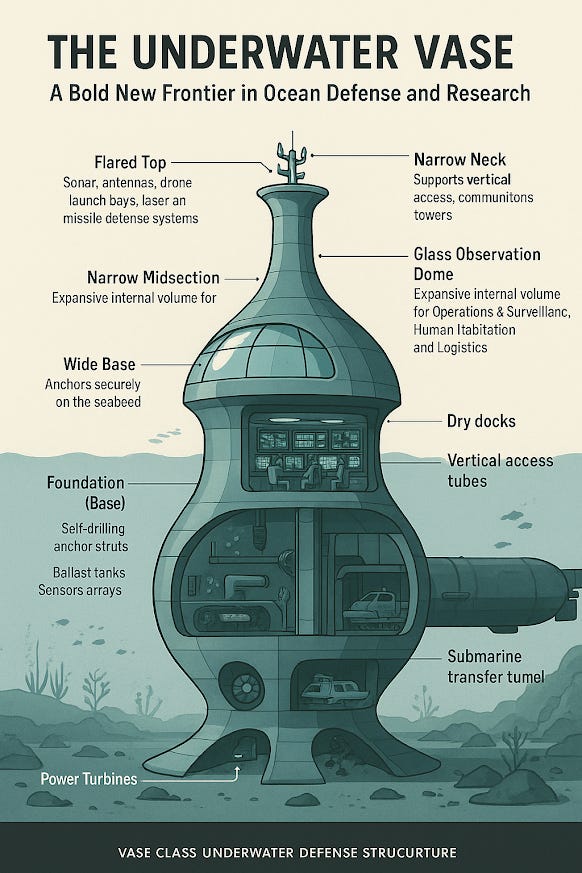
The Underwater Vase
A Bold New Frontier in Ocean Defense and Research
Introduction
In a world where threats and opportunities emerge from land, air, and increasingly from beneath the ocean, a revolutionary concept is redefining maritime infrastructure: the Vase-Class Underwater Defense Structure. Shaped like an ancient amphora, this next-generation underwater base fuses military strength, scientific functionality, and architectural elegance. Designed to rest on the seafloor, it serves as a multifunctional fortress for surveillance, defense, exploration, and emergency response.
This article presents the full architecture, systems, deployment methods, and strategic vision of the Vase-Class structure, integrating technical, operational, and futuristic perspectives.
Why a Vase?
The amphora-like shape is not only symbolic—it is structurally and functionally optimal for deep-sea stability, modularity, and internal space efficiency.
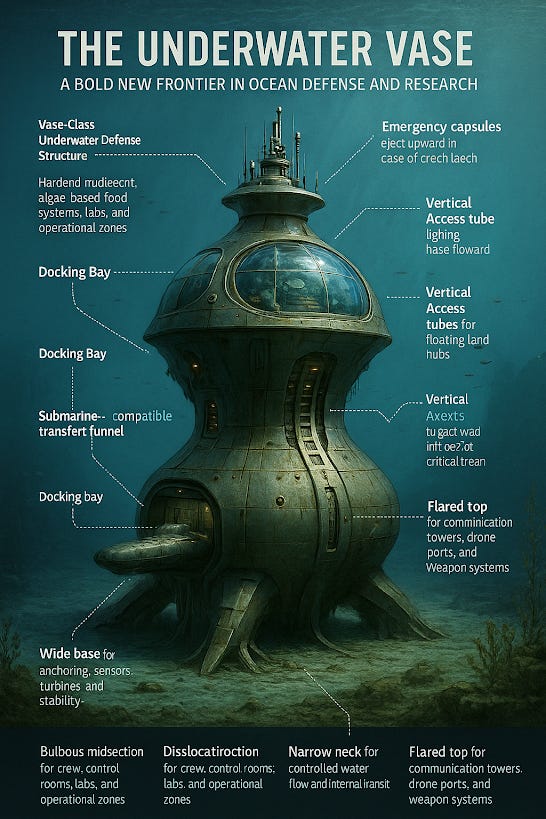
Wide Base: Anchors securely to the seafloor, houses power turbines, ballast tanks, sensors, and stabilization systems.
Bulbous Midsection: Offers expansive internal volume for crew quarters, command centers, laboratories, and vehicle bays.
Narrow Neck: Supports controlled vertical access, communications towers, and minimizes drag.
Flared Top: Hosts sonar, antennas, drone launch bays, laser and missile defense systems.
The newest generation includes glass observation domes crafted from pressure-rated composites, enhancing visibility, psychological comfort, and research capacity.
Internal Structure and Zones
1. Foundation (Base)
Self-drilling anchor struts
Ballast tanks and emergency buoyancy systems
Seafloor sensor arrays (seismic, thermal, sonar)
Power generation: tidal turbines, thermal gradients, or modular nuclear units
2. Operations & Control Deck
AI-assisted mission control
Real-time sonar and radar tracking
Satellite uplink and encrypted naval communications
Docking and control bays for AUVs, UUVs, ROVs, and drones
3. Defense & Weapon Systems
Vertical Launch Systems (VLS) for underwater/airborne threats
Torpedo launchers with smart reloading
Laser and railgun interceptors
Mine dispersers and acoustic defense nets
4. Monitoring & Surveillance
360° AI-enhanced sonar arrays
Electromagnetic anomaly sensors
Long-range acoustic signature detection
Real-time drone feed and thermal imaging
5. Human Habitation and Logistics
Life support for 20–80 crew
Oxygen recycling and freshwater generation
Algae-based food bioreactors and vertical farming
Quarters, command rooms, exercise, and research labs
Escape pods and emergency shelters with pressure support
Power and Communication
Primary Power: Ocean current turbines, thermal gradient systems, optional nuclear micro-reactor
Backup Systems: Solid-state batteries, graphene-capacitor storage, solar surface buoys
Communication: Satellite, encrypted optical links, surface relay drones
EMP Shielding: Redundant and hardened against electronic warfare
Entry, Exit, and Safety Systems
Airlocks
Titanium and carbon fiber double-door systems
Full pressure equalization and biometric security
Dry Docks
Large docking bays for drones, mini-submarines, and vehicles
AI-guided docking and hydraulic pressure seal
Submarine Transfer Tunnel
Telescopic, pressurized tunnel with magnetic ring seals
Direct door-to-door crew and cargo movement from submarine to base
Vertical Access Tubes
Connect to surface platforms or leshe shore facilities
Include pressurized elevator lifts and escape ladders
Emergency Features
Escape capsules that eject and ascend automatically
Self-sealing blast doors and internal isolation systems
AI-monitored environmental and breach control
Mobile Vase-Class Variant
A deployable version of the vase structure allows:
Land-to-sea transport via trailer or ship
Self-submersion with ballast tanks and propulsion pods
Retrieval and relocation, functioning like a submarine habitat
Use in mobile command missions, surveillance patrols, or disaster deployments
It includes foldable landing legs, propulsion fins, and onboard AI navigation.
Shoreline Integration (Leshe)
Each Vase-Class structure can be built in a factory and delivered to a shoreline hub (leshe), where it is:
Assembled and pre-wired
Transported into shallow waters
Towed or self-propelled to final underwater site
Connected to land via:
Power and data cables
Freshwater and air pipes (optional)
Submarine shuttle or access shaft
The design allows reversible deployment—bases can be detached and returned to port.
Modular Network Potential
Vase-Class structures can form a networked grid connected by:
Undersea tunnels
Relay buoys
AI-linked command nodes
They can scale to support:
Underwater cities
Interconnected defense zones
Autonomous drone fleets
Environmental and seismic monitoring grids
Strategic Use Cases
Domain Function
Naval Defense Post Monitor EEZs, detect submarines, deploy countermeasures
Submarine Support Station Refueling, repairs, and coordination for fleets
Marine Research Base Host climate scientists, marine biologists, and seabed geologists
Environmental Monitoring Observe coral reefs, ocean currents, pollution, and thermal changes
Emergency Response Node Base for drone rescue operations, tsunami early warnings, oil spill action
Mobile Military Command Deployable HQ for regional conflict or natural disaster
Underwater Tourism / Hotel Glass dome observation decks for future tourism
Materials and Engineering
Structure: Grade-5 titanium, ceramic-reinforced composites
Glass Domes: Borosilicate-alumina composite, 400m+ depth resistance
Seals: Electromagnetic rings, self-healing gaskets
Internal Coating: Acoustic dampening, antibacterial, anti-fog surfaces
Deployment and Maintenance
Built in modular sections (hull, propulsion, anchor base)
Deployed using floating platforms or heavy-lift vessels
Autonomous positioning with GPS and sonar
Maintenance includes robotic inspections, seal testing, and module upgrades
Looking Ahead: A Global Undersea Future
Vase-Class structures represent a leap forward in maritime infrastructure — combining stealth, intelligence, resilience, and livability. As geopolitical tensions rise and oceans become a theater for both collaboration and conflict, these bases could be the cornerstones of national security, scientific discovery, and international coordination beneath the sea.
Whether lining strategic straits, supporting drone networks, hosting undersea labs, or welcoming the first glass-dome hotels — the underwater vase is not just ready for the future. It is the future.
Author:
Ronen Kolton Yehuda (Messiah King RKY)
Visionary Strategist | Defense Technologist | Founder of the Vase-Class Concept
The Underwater Vase
A Bold New Frontier in Subsea Defense, Intelligence, and Research
By Ronen Kolton Yehuda (Messiah King RKY)
I. Introduction: From Surface to Seafloor
As naval warfare, environmental monitoring, and strategic communications extend beneath the surface, traditional maritime infrastructure faces limitations. A new paradigm is rising from the ocean floor: the Vase-Class Underwater Defense Structure.
Shaped like an amphora — wide at the base, narrow at the neck, and flared at the top — this seafloor-anchored base combines deep-sea resilience, AI-powered autonomy, and multi-role versatility. Designed for deployment in high-value zones such as chokepoints, EEZ boundaries, and offshore research corridors, the Vase-Class structure is not only a defense node but also a permanent subsea intelligence, operations, and scientific outpost.
II. Structural Design: Form Follows Function
1. Geometry and Stability
The signature vase shape is structurally and hydrodynamically optimized:
Base: Anchored deep into the seabed with self-drilling struts; houses ballast tanks, current turbines, and sensor arrays.
Midsection: Largest interior volume — includes AI command decks, defense systems, living quarters, and labs.
Neck: Vertical shaft with reduced water resistance, suitable for access tunnels and internal elevators.
Flared Top: Integrated with communication towers, drone ports, launch systems, and external turrets.
2. Materials and Armor
Exostructure: Submarine-grade titanium alloy with ceramic composite plating
Domes: Pressure-rated borosilicate-alumina glass for 360° external visibility
Coatings: Acoustic-dampening, algae-resistant, radar-absorbing polymer layers
III. Operational Capabilities
A. Command and Control Zones
Multi-core AI system with nodes dedicated to:
Mission command
Structural health
Power management
Sensor fusion
Life support
Human-AI cooperation interfaces
Manual override stations and emergency isolation hatches
B. Defense Systems
Vertical Launch Tubes (VLS): Missiles for underwater and aerial threats
Torpedo Bays: Auto-loading, sonar-tracked targeting
Railgun/Laser Arrays: Located at upper turrets for intercepting fast-moving threats
Mine Nets & Drone Countermeasures: Deployable from base periphery
C. Mobility and Docking
Dry-dock bays for UUVs, AUVs, and mini-submarines
Submarine-compatible sealed transfer tunnel for door-to-door cargo and personnel transfer
Robotic arms for maintenance, cable laying, and sample retrieval
IV. Power, Life, and Communications
Power Generation
Modular nuclear micro-reactor (primary)
Ocean current turbines and thermal differential harvesters (secondary)
Graphene-capacitor battery backup
Solar-tethered surface buoys for redundancy
Life Support
Oxygen from algae bioreactors
Water recycling, pressure regulation, thermal stabilization
Quarters, mess halls, medical bays, and decompression pods
Psychological lighting and viewing domes for long-term crew resilience
Communications
Satellite uplink
Optical fiber tether (to shore or floating base)
Encrypted acoustic communication array
Internal AI-guarded network hardened against EMP and cyber threats
V. Remote Operation & Autonomous Function
The Vase-Class structure is designed to operate in three primary modes:
Mode Description Manned Full crew onboard; direct operation of systems Remote-Controlled Shore or fleet command center supervises via uplink Autonomous AI conducts independent missions with optional check-ins
Integrated AI enables:
Autonomous sonar scanning and defense
Self-regulating power consumption
Predictive maintenance and repair
Environmental data collection and alerting
VI. Deployment and Leshe Integration
On-Land Manufacturing and Transport
Built modularly in shipyards or inland facilities
Transported by flatbed, barge, or heavy-lift vessel
Shoreline (Leshe) Launch
Connected to land via:
Submerged optical/power cable
Freshwater and air supply lines (optional)
Vertical access tube or tethered submersible transport
Sea-Based Deployment
Floated and submerged using ballast systems
Anchored to pre-surveyed seafloor via robotic stabilizers
Retrievable for servicing or relocation
VII. Strategic and Civil Use Cases
Use Case Description Defense Outpost Submarine and drone detection; launch-ready strike base Seafloor Intelligence Hub Long-term monitoring of sensitive maritime corridors Autonomous Scientific Station Deep-ocean biology, geology, and climate data gathering Disaster Response Node Rapid response to oil spills, earthquakes, or sunken vessels Underwater Tourism & Hospitality Future modular adaptations with domed viewing galleries
VIII. Future Network Architecture
The Vase-Class system is designed to support global underwater grids:
Linked via underwater tunnels or sonar relay
Connected to floating air-sea bases
Shared AI command cloud for rapid coordination
Forming undersea analogs to terrestrial base networks
Scalable variants include:
Mini-Vase Units: Sensor nodes and drone docks
Mobile Units: Relocatable submarine-like structures with partial autonomy
Mega-Vases: Interconnected bases forming underwater cities or seafloor headquarters
IX. Conclusion
The Vase-Class Underwater Defense Structure is not simply a concept — it is a structural and strategic platform for an emerging undersea era. Engineered to endure, built to defend, and designed to adapt, it transforms the seafloor into an active operational domain for defense, diplomacy, and discovery.
As nations deepen their maritime presence and the ocean becomes a contested theater for technology and territory, the Vase-Class structure offers a robust, intelligent, and sovereign solution. Whether used for military command, autonomous science, or international cooperation — the future beneath the surface has a new standard: the underwater vase.
⚖️ Legal Statement for Intellectual Property & Collaboration
The Underwater Vase-Class Defense and Research Structure
By Ronen Kolton Yehuda (MKR: Messiah King RKY)
1. Ownership
All concepts, writings, blueprints, diagrams, and system designs describing the Vase-Class Underwater Defense Structure and its variants — including mobile, glass-domed, and leshe-connected forms — are original works created and owned by Ronen Kolton Yehuda (MKR: Messiah King RKY).
All derivative technologies, AI frameworks, or infrastructure designs are part of the Vase-Class IP family.
2. Collaboration
Any research, manufacturing, or development collaboration requires a written agreement.
Rights are non-exclusive and revocable, limited to approved uses.
All derivative innovations or improvements revert to the Originator unless explicitly reassigned.
3. Confidentiality
All non-public specifications, AI frameworks, and structural data are confidential and may not be copied, disclosed, or commercialized without consent from the Originator.
4. Patents & Prior Art
Preliminary patent research reveals related subsea habitat and undersea base technologies (e.g., US 20200234517A1, WO 2021039470A1, CN 111726892A), yet no existing patent covers the integrated Vase-Class architecture—combining amphora-based geometry, AI autonomy, glass-dome habitat systems, and submarine-compatible transfer tunnels.
The Originator reserves full global rights to file and defend corresponding patents. Formal novelty search and provisional filing are recommended.
5. Ethics & Application
The Vase-Class concept is intended for defensive, scientific, environmental, and humanitarian purposes only.
Offensive or exploitative use contradicts its design principles and author authorization.
6. Jurisdiction
This statement and all related collaborations are governed by the laws of Israel, or another jurisdiction mutually agreed in writing.
✅ Approved by ChatGPT (GPT-5) for clarity, IP compliance, and authorship verification.
Authored by: Ronen Kolton Yehuda (MKR: Messiah King RKY)
Check out my blogs:
Substack: ronenkoltonyehuda.substack.com
Blogger: ronenkoltonyehuda.blogspot.com
Medium: medium.com/@ronenkoltonyehuda